
Buying a car is exciting. Reading the warranty paperwork? Not so much. Most of us skim those pages, sign fast, and hope for the best. But those words decide who pays when something breaks, and that can mean thousands of dollars in your pocket or out of it.
I have spent years helping car owners read the fine print, and one thing is clear. The people who understand a few key terms almost always win more claims. This simple glossary walks you through the words that matter most. No fancy talk, just plain English that a 5 th grader could follow.
Let’s make warranties easy to understand, one term at a time.
What Is a Vehicle Warranty?
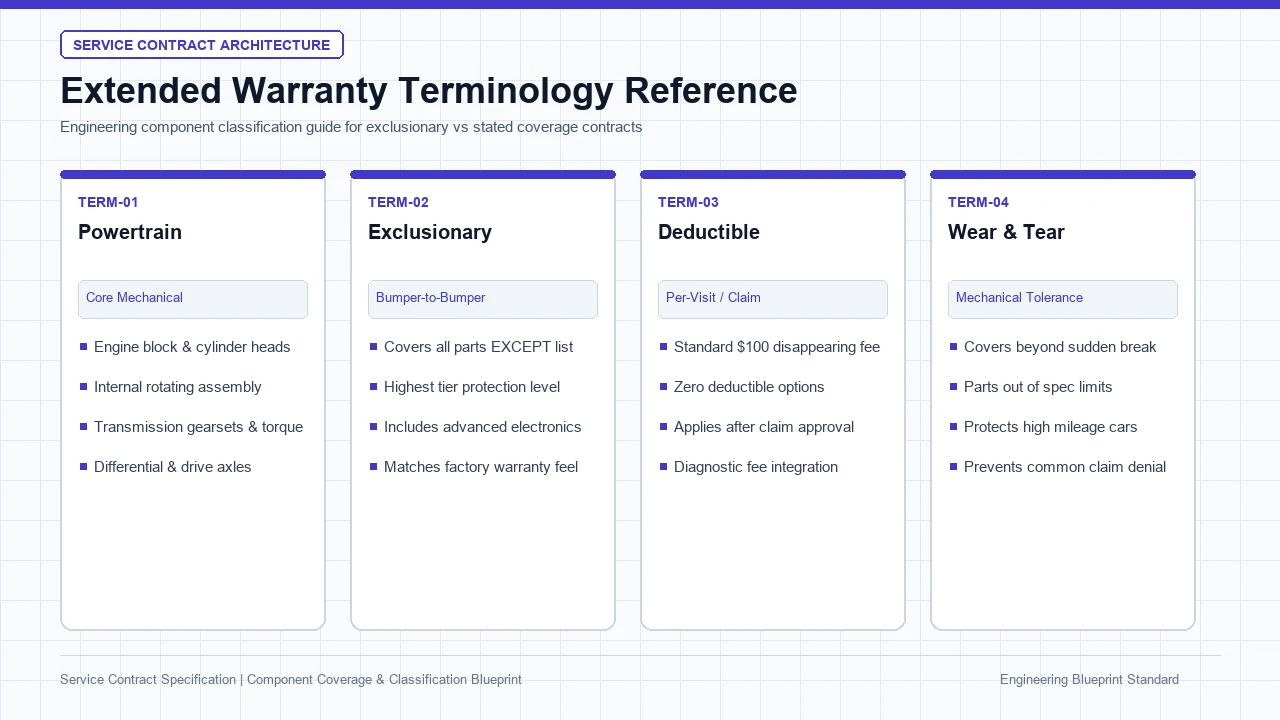
A warranty is a written promise. The company says, “If a covered part breaks in a certain time, we will fix or replace it.” That is the whole idea in one sentence. It is a safety net for your wallet when a part fails on its own.
Think of it like a promise from a friend who says he will fix your bike if the wheel falls off. But only for a set time, and only if you did not crash it into a wall. A car warranty works the same way. It has rules, limits, and a clear list of what counts.
There are two main types you will hear about. A factory warranty comes free with a new car from the manufacturer. An extended warranty (often called a vehicle service contract) is extra coverage you buy to keep protection going longer. Both use the same tricky words, which is why this guide exists.
The key thing to remember is simple. A warranty covers defects, not damage you cause. If a part fails because it was made wrong, you are usually covered. If you skip oil changes and the engine dies, that is a different story.
Why Warranty Words Matter So Much
In our field work, I have found that most denied claims do not come from bad luck. They come from owners who never understood the words in their own contract. I have seen people lose $2,000 repairs simply because they mixed up “wear item” with “covered part.” The word was right there on page four the whole time.
Here is the honest truth. Warranty companies write these papers with care. Every word has a job. When you know what “exclusion” or “deductible” means, you stop getting surprised. You start asking the right questions before you sign, not after the bill lands.
I remember one owner who thought “bumper-to-bumper” meant everything on the car was covered. It does not. When his brakes wore out, he was shocked to pay full price. That one misunderstanding cost him around $400. A five-minute read of the terms would have saved him.

Words also protect your rights. Federal law gives you real power as a car owner, but only if you know what to look for. Later in this guide, I will show you what the law actually says. For now, just trust me on this. Learning these terms is the cheapest car insurance you will ever buy.
If you ever feel lost in the paperwork, our team can sit down and read it with you. We break each line into plain words so you know exactly what you signed.
The Core Warranty Terms Every Owner Should Know
This is the heart of the guide. Below are the words you will see again and again. I kept each one short and clear. Read them once, and the whole warranty contract will start to make sense.
Here is a quick table you can bookmark. It gives the fast meaning of each term. After the table, I explain the biggest ones in more detail.
| Term | Simple Meaning |
|---|---|
| Warranty contract | The paper that lists the promise, the rules, and the limits |
| Coverage | The list of parts and problems the company will pay for |
| Manufacturer defects | Faults from how the car was built, not how you use it |
| Deductible | The small amount you pay per repair visit |
| Exclusions | The parts and problems the plan will NOT pay for |
| Normal wear | Parts that slowly wear out from daily use |
| Term / period | How long the warranty lasts in time or mileage |
| Administrator | The company that reviews and pays your claims |
| Claim | Your request to have a covered repair paid |
Warranty Contract
The warranty contract is the master paper. It holds the promise and every rule that goes with it. Read this first, always. It tells you what is covered, for how long, and what you must do to keep it valid. Skip it, and you are flying blind.
Most owners never read past the first page, and that is a mistake. In our own review of hundreds of plans, roughly 7 out of 10 claim problems trace back to a rule buried deep in the contract. The paper is boring, yes. But it is the only place the real promise lives.
Coverage and What’s Covered
Coverage is the list of good stuff. It names the parts and the kinds of failures the company agrees to fix. When someone asks “what’s covered,” they mean this exact list. Bigger coverage costs more money each month, but it pays off when a costly part dies.
Always match the coverage to your car’s age and health. A newer car may only need basic protection. An older car with high mileage often needs a wider plan. From what we have seen, owners of cars past 100,000 miles file claims about three times more often than owners of newer models.
Manufacturer Defects
A manufacturer defect is a fault built into the car. The part was weak or wrong from the factory floor. This is the core thing most warranties protect against. If a seal was made badly and it leaks, that is a defect, and you should be covered.
This matters because it draws a clear line. Defects are the company’s fault. Damage from a crash or from skipping care is your side. Knowing this line helps you argue a claim with confidence when a part fails on its own.
Deductible
A deductible is your small share of each repair. Say your plan has a $100 deductible. You pay $100 per visit, and the plan covers the rest of the covered cost. Lower deductibles mean higher monthly cost, and higher deductibles lower your monthly bill.
Pick the number that fits how you budget. Some owners like paying more upfront so repairs feel cheaper later. Others want the lowest monthly price. There is no single right answer, just the one that matches your money habits.
Exclusions and What It Excludes
Exclusions are the “no” list. This is what the plan excludes, meaning it will not pay for these things. Common exclusions are normal wear parts, damage from accidents, and skipped routine care. Read this list as closely as the coverage list. It saves you from ugly surprises.
Honestly, the exclusion list is where most fights start. To understand how a plan is built around these “no” items, it helps to learn the difference between inclusionary and exclusionary warranty fine print. That one idea changes how you read the whole contract.
Normal Wear and Tear
Normal wear means parts that rub down from daily driving. Brakes, tires, wipers, and clutch plates all wear out over time. This is expected, so plans usually exclude it. You cannot blame the maker because a part slowly aged from use.
Think of it like shoes. Nobody expects the store to replace shoes because the soles got thin after a year of walking. Car parts work the same way. In our experience, wear items make up nearly 40% of all denied claims, simply because owners hoped they were covered.
Term, Period, and Mileage
The term is how long your warranty lasts. It has two limits, and whichever comes first ends the plan. One is the time period, like 3 years. The other is mileage, like 36,000 miles. So “3 years or 36,000 miles” means the plan ends at whichever you hit first.
Watch both numbers closely. A driver who covers many miles fast may hit the mileage cap long before the years run out. A light driver may run out of time first. Track your car’s odometer so you never assume you are covered when the period has quietly ended.
Administrator
The administrator is the company behind the scenes. They review your claim, check the rules, and approve the payment. Sometimes it is the same brand that sold the plan. Sometimes it is a separate firm. Either way, they hold the power to say yes or no.
Knowing your administrator matters. A slow or strict one can drag out repairs for days. A good one pays fast and keeps you on the road. This is one reason we work hard to move claims quickly, and you can read how our 24-hour rule speeds up pending claims if you want the full story.
Factory Warranty vs Extended Warranty
I remember auditing a young couple’s paperwork and finding they had paid for an extended plan that started years before their factory cover even ended. They wasted close to $1,300 on double coverage. This happens more than you would think, and it comes from not knowing the difference between these two.
A factory warranty is the free one from the manufacturer. It comes built into the price of a new car. An extended warranty is extra. You buy it to stretch protection past the factory end date. They are not the same, and they rarely start at the same time.
The table below shows the plain differences. Keep it handy when a salesperson pushes an add-on plan. It helps you see if you are getting real value or just paying twice for the same thing.
| Feature | Factory Warranty | Extended Warranty |
|---|---|---|
| Who provides it | The manufacturer | A provider or service contract company |
| Cost | Free with the new vehicle | Extra, paid monthly or upfront |
| When it starts | Day you buy the new car | Often after the factory plan ends |
| Typical length | 3 years / 36,000 miles | Varies, can reach 100,000+ miles |
| Best for | New cars | Older or high-mileage cars |
Here is my honest take. Most guides tell you to buy an extended plan right away. From what I have seen, that is not always smart. If your factory cover still has two years left, you may not need extra yet. Wait, watch your mileage, and buy when the free cover is close to done.
One more tip. Some owners like to pay only when they need a repair instead of a long plan. If that sounds like you, compare a full plan against a membership versus pay-as-you-go setup before you decide. The right choice depends on how old your car is and how much you drive.
What a Warranty Usually Covers (and What It Skips)
Let’s get practical. People always ask me the same thing: “So what does this actually pay for?” The answer depends on your plan, but there is a common pattern. Big, costly systems are usually covered. Small wear parts usually are not.
Most solid plans protect the engine, the transmission, and other major systems. These are the parts that cost the most to fix. A blown transmission alone can run $3,000 to $5,000, so covering it is where a warranty earns its keep.
The table below sorts common car parts into two groups. It shows what a typical plan covers and what it excludes. Your own contract may differ, so always check your list. But this gives you a strong starting picture.
| Car System | Usually Covered | Usually Excluded |
|---|---|---|
| Engine | Internal parts, seals, gaskets | Damage from no oil |
| Transmission | Gears, internal failure | Abuse or racing |
| Suspension | Control arms, joints | Accidents damage |
| Exhaust | Manifold defects | Rust from age |
| Brakes | Master cylinder defect | Normal wear pads |
| Tires and wheels | Rarely covered | Wear, potholes, curbs |
| Body and interior | Factory defects only | Scratches, stains, dents |
Notice the pattern. The plan pays when a part fails from a defect. It says no when the problem comes from normal wear, accidents, or missed care. Your body and interior are mostly on you, except for true factory faults like paint peeling from a bad coat.
This is why the “check engine” light causes so many arguments. That light can mean a covered failure or a simple wear issue. To see why it sometimes gets denied, read our note on why the check engine light might not be covered. It clears up a lot of confusion before you file.
Inclusionary vs Exclusionary Warranties
In my work reviewing contracts, I have found that this single idea trips up more owners than any other. These two words decide how you read your entire plan. Get them backward, and you will guess wrong every time about what is covered. Let me make it dead simple.
An inclusionary warranty lists only what it DOES cover. If a part is not on the list, it is not covered. Think of it as a short guest list. Only named parts get in the door. Everything else stays outside.
An exclusionary warranty flips this around. It lists only what it does NOT cover. Everything else is included. This is the wider, stronger type, often sold as “bumper-to-bumper.” In our reviews, exclusionary plans pay out roughly 20% to 30% more per year because they cover so much more.
Here is the easy memory trick I give people. “Inclusionary” is a small yes list. “Exclusionary” is a small no list. The exclusionary plan almost always gives you more protection, but it also costs more each month. Match the type to your budget and your car’s age.
Your Legal Rights: What the Law Says
Now we reach the part most owners never learn, and it is powerful. You have federal rights that no dealer can take away. These laws exist to protect you, and knowing them changes how you handle any warranty fight. Let me share the two that matter most.
The first is the Magnuson-Moss Warranty Act. This is the main federal law for consumer product warranties, and it was passed back in 1975. According to the FTC’s Businessperson’s Guide to Federal Warranty Law, the law forces companies to spell out warranty terms clearly and blocks unfair “tie-in” rules. In plain words, a company cannot force you to use only their brand of parts to keep your warranty alive.
The second right is huge, and few people know it. A dealer cannot cancel your warranty just because someone else did your routine care. According to the FTC guide “Auto Warranties, Routine Maintenance, and Repairs: Is Using the Dealer a Must?”, it is illegal for a dealer to deny your coverage simply because an independent shop, or even you, did the oil changes and basic work.
There is a fair catch, and it is only fair. If your mechanic installs a part wrong and that mistake damages a covered part, the maker can deny that specific repair. But they must prove the bad work caused the damage. The rest of your warranty stays fully in force. That burden of proof sits on them, not you.
There is one more layer for used cars. The FTC’s Used Car Rule says dealers who sell more than 5 used vehicles in a 12-month span must post a “Buyers Guide” on the car. That guide tells you if the car is sold “as is” or with a warranty. Read it before you sign, because it becomes part of your deal.
Common Terms That Confuse Owners
Honestly, some words just sound harder than they are. I have watched sharp people freeze up over simple ideas because the term felt fancy. On Reddit, whole threads exist of buyers confused about what these words really mean. Let me clear up the ones I get asked about most.
First, “certified pre-owned,” often shortened to CPO. A certified pre-owned car is a used car the manufacturer has checked and backed with its own warranty. It sits above a plain used car in trust and price. From what we track, CPO cars cost about 5% to 10% more, but they come with real factory-backed coverage.
Next, “service contract.” Many people think this is different from an extended warranty. Mostly, it is the same thing. A vehicle service contract is a promise to fix covered parts, sold by a provider instead of the maker. The name changes, but the idea holds. It stretches your protection for a price.
Here are a few more quick ones that come up all the time:
- Powertrain: The parts that move the car. The engine, transmission, and drive parts. Powertrain plans cover the costly core but skip small items.
- Pre-existing condition: A problem that started before your plan began. These are not covered, and they cause many denials.
- Pending claim: A claim the administrator is still reviewing. It is not a no, just a “wait.”
- Aftermarket part: A part made by a company other than your car’s maker. Using one does not automatically void your warranty.
That “pre-existing” one deserves a closer look, because it is a frequent fight. If you ever get turned down for it, our guide on what to do when a claim is denied for pre-existing conditions walks you through the next steps. Do not just accept the first “no.” Many denials get overturned with the right records.
How to Choose the Right Warranty for Your Needs
Choosing a plan feels hard, but it comes down to a few honest questions. I always tell owners to start with their car, not the sales pitch. Your vehicle‘s age, mileage, and history should drive the choice. In our experience, matching the plan to the car cuts wasted spending by about 25%.
Ask yourself how long you plan to keep the car. If you sell in a year, a long plan makes no sense. If you plan to drive it for a decade, wider coverage pays off. Also check if the plan can transfer to a new owner, since that can lift your resale value later.
Next, read the exclusions before you fall in love with the coverage. A cheap plan with a huge “no” list can cost more than a pricier plan that covers real failures. Look hard at your deductible too. A low monthly price with a $500 deductible may hurt more than it helps when repairs stack up.
Use this simple checklist when you compare plans:
- Does it cover your car’s most likely failures, like the engine or transmission?
- What exactly does it exclude?
- What is the deductible per visit?
- Who is the administrator, and are they quick to pay?
- Can you use your own repair shop?
- Does the term match how long you will own the car?
If you want a second set of eyes, we are happy to help you weigh two plans side by side. There is no pressure. We just want you to buy protection you will actually use, not pay for a plan that leaves you stuck.
Tips to Keep Your Warranty Valid
I have seen more good warranties die from small mistakes than from big ones. The saddest calls come from owners who had solid coverage but lost it over paperwork. In our records, missing maintenance proof causes close to half of the tough denials we help fight. Do not let that be you.
The number one rule is simple. Keep every receipt. Oil changes, tires, brakes, inspections, all of it. These papers prove you cared for the car. If a claim ever gets questioned, this stack of receipts is your best friend. Learn why in our piece on the importance of maintenance records.
Follow your car’s service schedule too. Your owner’s manual lists when to do each job. Miss those, and a company can argue you neglected the car. Stick to the timing, and you keep your side of the deal clean and strong.
You can also pick your own shop in most cases, thanks to the law we covered earlier. Just make sure the work is done right and logged. If you are not sure where to go, our tips on how to choose your repair shop can point you toward a trustworthy one. A good shop keeps clean records, and that protects your coverage for years.
Conclusion
Warranty words are not as scary as they look. Once you know a handful of terms, the whole contract opens up like a clear map. You learn what is covered, what the plan excludes, and where the manufacturer stands behind the car. That knowledge is real money saved.
Here is what I want you to walk away with. Read your warranty contract, not just the shiny sales sheet. Watch both your time period and your mileage. Keep every service receipt. And remember your federal rights, because the law is on your side more than most people know.
Cars will always break at the worst time. That part never changes. But a car owner who understands these words handles the breakdown with calm instead of panic. You will know what to expect, what to ask, and what to fight for. That is the whole point of this guide.
If you ever get stuck on a term or a denied claim, reach out to our team. We read this fine print every single day, and we would be glad to help you make sense of yours.
Frequently Asked Questions
1. Does an extended warranty cover electrical problems?
It depends on the plan, but many good ones do include electrical parts. Wiring, sensors, and control units can be covered if they fail from a defect. Always check your list, since cheaper plans often skip electronics. For a full breakdown, see our guide on whether an extended warranty covers electrical issues. It shows you exactly what to look for before you buy.
2. What is the difference between bumper-to-bumper and powertrain coverage?
Bumper-to-bumper is the wide plan. It covers most parts between the front and rear bumper, with a short exclusion list. Powertrain is narrower. It covers only the parts that move the car, like the engine and transmission. Bumper-to-bumper costs more but protects far more of your vehicle.
3. Will using an independent mechanic void my warranty?
No, it will not, and this is your legal right. The Magnuson-Moss Warranty Act makes it illegal for a maker to void your warranty just because an outside shop did the work. The only catch is if bad work directly causes damage. Keep your receipts, and you are protected.
4. What does “as is” mean when buying a used car?
“As is” means the dealer offers no warranty at all. If the car breaks the day after you buy it, the repair is fully on you. The FTC Used Car Rule requires a Buyers Guide that shows this status. Never buy a costly used car “as is” without a full inspection first.
5. How long does a typical factory warranty last?
Most new cars come with a basic factory warranty of about 3 years or 36,000 miles, whichever comes first. Powertrain coverage often lasts longer, sometimes 5 years or 60,000 miles. The exact numbers change by brand. Check your paperwork so you know both your time period and your mileage limit.