The moment that the orange light appears on your dashboard, your stomach drops a little. I get it. I once ignored mine for two weeks, thinking it would just go away. It did not. By the time I brought the car in, what started as a small vacuum leak had grown into a bigger repair. So yes, that light matters.
But here is what most people do not know. Even if your car is still under warranty, the check engine light repair might not be covered. Why? Because it depends entirely on what caused it. The warranty does not cover everything. It covers defects. And there is a big difference between a factory defect and normal wear and tear.
Let us break this down in simple terms, so you know exactly what to expect when you walk into a shop.
What Does the Check Engine Light Actually Mean?
How Your Car Talks to You Through Warning Lights
Your car has a small but smart computer inside called the ECU (Engine Control Unit). All day long, it watches hundreds of sensors. When one of those sensors sends back a reading that looks wrong, the ECU saves a code. That code is called a Diagnostic Trouble Code or DTC. Then it turns on your check engine light to tell you something is off.
The light itself does not tell you what is wrong. It only tells you that something is wrong. Think of it like a fire alarm. The alarm goes off. But you still need to find where the fire is.
According to Kelley Blue Book, OBD-II codes (the system used in most cars made after 1996) include four main types: P for powertrain, B for body, C for chassis, and U for network and wiring. Most check engine lights are tied to a P-code, which means the engine or transmission area.
Solid Light vs. Flashing Light: What Each One Means
Not all check engine lights are equal. A solid yellow or orange light usually means a non-emergency issue. Your car is still safe to drive for a short time, but you should get it checked soon.
A flashing check engine light is different. That is your car screaming at you. It usually means the engine is misfiring badly, which can destroy the catalytic converter quickly. If you see a flashing light, reduce speed and get the car to a shop the same day.
Do not ignore a flashing check engine light. A small misfire that costs $100 to fix can damage a catalytic converter that costs $1,500 or more to replace.
Why Your Check Engine Light Might Not Be Covered by Warranty
The Difference Between a Defect and Wear and Tear
This is where a lot of people get confused. A factory warranty covers defects in materials or workmanship. That means if something was made wrong from the start and it breaks, the manufacturer pays to fix it.
But wear and tear is a different story. Brakes wear down. Spark plugs get old. Oxygen sensors eventually fail after years of use. These things happen naturally. They are not defects. And most warranties do not cover them.
As one experienced service manager explained on Quora, the cause of the check engine light must be a factory-defective component for it to be fully covered. Not a loose gas cap. Not a worn gasket on the fuel cap. Not a sensor that simply aged out.
Common Reasons a Check Engine Light Is Not Covered
Here are the situations where your warranty will most likely say no:
| Cause | Covered by Warranty? | Why |
| Loose or cracked gas cap | No | Driver responsibility |
| Worn spark plugs | No (usually) | Normal wear item |
| Aftermarket parts installed | No | Voids coverage |
| Damage from bad fuel | No | External cause |
| Environmental damage (flood, fire) | No | Not a manufacturing fault |
| Faulty O2 sensor (factory defect) | Yes (if under warranty) | Manufacturing defect |
| Failed emissions component | Yes (federal 8/80 rule) | Emissions warranty law |
There is one exception worth knowing. In the United States, the federal government requires all automakers to cover emissions-related components for at least 8 years or 80,000 miles. This includes the catalytic converter, the onboard diagnostics system, and related emissions sensors. So if your check engine light is tied to an emissions fault, you may still be protected even if your bumper-to-bumper warranty has expired.
Good to know: In California, emissions coverage extends to 100,000 miles by state law. If you live in California, you may have extra protection.
How We Check First Before Any Repair Starts
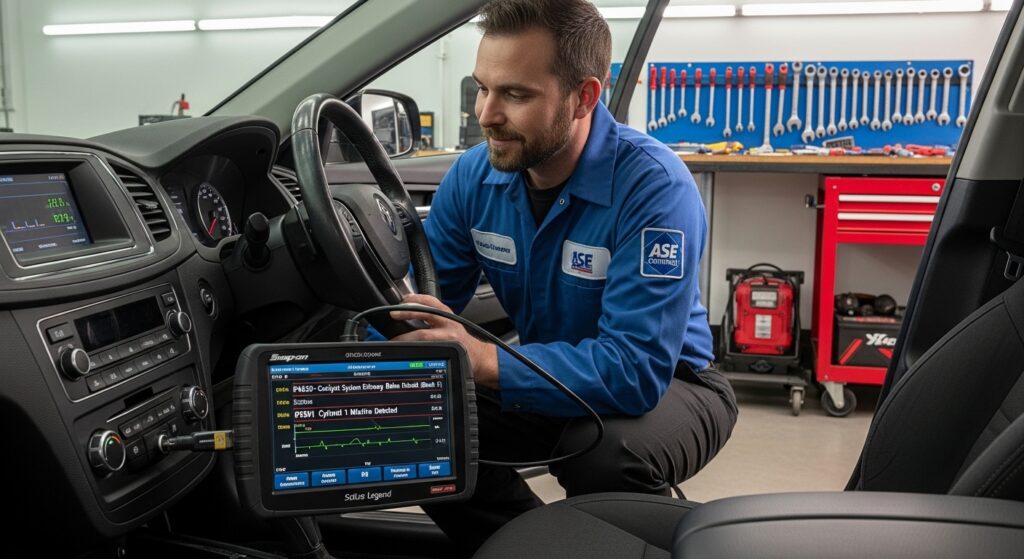
Step 1: OBD-II Scan to Pull the Trouble Codes
When your car comes in, the very first thing a good mechanic does is plug a scan tool into the OBD-II port. This port is usually under the dashboard on the driver’s side. The scanner reads every trouble code stored in your car’s computer.
Those codes look like this: P0171, P0420, P0300. Each code point refers to a specific area of the car. P0420 means the catalytic converter efficiency is below the threshold. P0300 means random engine misfire. The code gives the mechanic a starting point, not a final answer.
Honestly, a lot of people think one code equals one repair. But that is not how it works. A P0171 code (engine running lean) could come from a vacuum leak, a bad mass airflow sensor, a clogged fuel injector, or low fuel pressure. The code is just a clue.
Step 2: Visual and Physical Inspection
After reading the codes, a thorough mechanic does a hands-on inspection. This is where experience really matters. They check things like the fuel cap, battery connections, vacuum hoses, wiring, and fluid levels. You would be surprised how often a simple loose hose is behind a complex-looking code.
According to Joy Automotive, a driver once ignored a check engine light for months. The code was P0171. A small vacuum leak had put extra strain on the oxygen sensor, causing it to fail early. What would have been a $50 hose fix turned into a $300 repair because the problem sat too long.
This is why we never jump straight to a repair. The visual check often reveals something the scanner alone cannot.
Advanced Diagnostics: When Codes Are Not Enough
Live Data and Real-Time Sensor Analysis
Sometimes the trouble code points to a system, not a specific part. In that case, the mechanic uses the scan tool to look at live data. This means watching the sensors in real time as the engine runs.
For example, if the code says there is an issue with the oxygen sensor, the mechanic can watch the O2 sensor readings live. If the sensor is responding slowly or stuck at one reading, it is likely failing. If it looks fine, but the air-fuel mixture is still off, the problem is somewhere else upstream.
This step is what separates a good diagnosis from a guess. Any shop can clear a code and hope the problem goes away. A real diagnostic tells you why the code is there in the first place.
Manufacturer-Specific Codes vs. Generic Codes
Here is something most people never hear about. There are two types of trouble codes. Generic codes (like P0300) work the same across all car brands. But car makers also store their own private codes, sometimes called manufacturer-specific codes. These start with P1 instead of P0.
A basic code reader from an auto parts store will only catch the generic codes. A professional scan tool catches both. This is important because manufacturer codes often lead straight to the specific faulty part, while generic codes only point to the general system.
This is one reason why free code scans at auto parts stores are helpful but limited. They give you a starting point. They do not give you a full picture.
What Happens After the Diagnosis
How We Tell You What Is and Is Not Covered
Once we know what the actual problem is, we can give you a clear picture of coverage. If the part is under your factory warranty, we submit the claim, and you pay nothing (or just a small deductible). If it falls outside warranty, we give you a written estimate before touching anything.
A good shop never starts work without your approval. This is your legal right in most US states. If a mechanic tells you they already fixed something without your go-ahead, that is a red flag.
We also look at whether you have an extended warranty or a vehicle protection plan. Some of these plans, depending on the provider, do cover things like oxygen sensors, fuel injectors, and other emission-related parts. It pays to know your plan details before assuming you will be paying out of pocket.
When to Push Back on a Denied Warranty Claim
Sometimes, dealerships deny claims that should be covered. It happens more than you think. If a dealer tells you an emissions-related repair is not covered, but your car is under 80,000 miles and less than 8 years old, do not just accept that answer.
Ask for the repair order in writing. Call the manufacturer’s customer service line directly. Most manufacturers will review the denial and, in many cases, will correct it. The law is on your side when it comes to federally mandated emissions coverage.
According to guidance shared by automotive experts on Quora, you can request a printout of all diagnostic trouble codes and technician notes as part of the warranty claim record. Keep these. They are your evidence if the claim is ever disputed.
How to Protect Yourself Before the Light Even Comes On
Simple Habits That Prevent Most Check Engine Light Issues
The best repair is the one you never need. Most check engine light causes are preventable with basic maintenance. Regular oil changes keep engine parts from wearing too fast. Replacing air filters on time helps the engine breathe properly. Checking your gas cap is tight after every fill-up costs nothing and takes three seconds.
AAA also recommends keeping your cooling system healthy. Low coolant or a failing thermostat can trigger warning lights and lead to expensive overheating damage if ignored.
Know Your Warranty Before You Need It
Most people do not read their warranty until something breaks. By then, it is often too late to make good decisions. Pull out your warranty booklet or download it from the manufacturer’s website. Look for two things: what is covered under bumper-to-bumper, and what falls under the powertrain warranty.
Also, check whether your car still has emissions coverage. In the US, federal emissions warranty law covers the catalytic converter, the OBD diagnostic system, and emissions control devices for 8 years or 80,000 miles on all cars sold since 1995. California extends that to 100,000 miles. This is separate from your regular warranty, and many drivers do not know it exists.
Conclusion
The check engine light is not your enemy. It is your car trying to tell you something before a small problem becomes a big one. And while it can be frustrating to find out a repair is not covered, knowing why ahead of time puts you in control.
The most important thing is that a good shop always checks first. We pull the codes, do the visual inspection, look at live sensor data, and confirm the real cause before quoting you a single dollar. That process protects you from unnecessary repairs and gives you the information you need to make a smart decision about your coverage.
If your check engine light is on right now, do not wait. The earlier you catch it, the more options you have. And the more you understand about how the diagnosis works, the less likely you are to be caught off guard.
I would love to hear from you. Has your check engine light ever led to a surprise that was or was not covered? Drop your experience in the comments below.
Frequently Asked Questions
Is the check engine light always covered under warranty?
No. The check engine light itself is just a signal. Whether the repair is covered depends on what caused it. Factory defects are covered. Normal wear and tear, loose gas caps, driver-caused damage, and aftermarket parts are not. Always let a mechanic diagnose the cause first before assuming coverage.
Can a dealership charge me a diagnostic fee even if my car is under warranty?
Yes, some dealerships charge a diagnostic fee upfront. However, if the repair turns out to be covered under warranty, that diagnostic fee should either be waived or submitted to the manufacturer as part of the warranty claim. If a dealership keeps the fee even when the repair is covered, contact the manufacturer’s customer service line directly.
What is the federal emissions warranty, and what does it cover?
US federal law requires all automakers to cover emissions-related parts for at least 8 years or 80,000 miles, whichever comes first. This includes the catalytic converter, onboard diagnostic system, and electronic emissions control unit. In California, this coverage extends to 100,000 miles. This applies even if your bumper-to-bumper warranty has already expired.
What is an OBD-II scan, and why does it matter?
An OBD-II scan reads the diagnostic trouble codes stored in your car’s computer. Every car made after 1996 has an OBD-II port. When the check engine light comes on, codes are stored that point to the area of the problem. A scan tool reads those codes. Free scans at auto parts stores catch generic codes, while professional tools also read manufacturer-specific codes, which give a more accurate diagnosis.
How long can I drive with the check engine light on before it becomes dangerous?
If the light is solid (not flashing), you can usually drive for a short time, but get it checked within a few days. If the light is flashing, stop driving as soon as it is safe and get the car to a shop the same day. A flashing check engine light typically means the engine is misfiring, which can damage the catalytic converter quickly and turn a small repair into a very expensive one.