
Does an extended warranty cover electrical issues? That is one of the biggest questions car owners ask when their factory warranty is about to run out. And honestly, it is a smart question to ask. Electrical repairs can get expensive fast, and the last thing you want is a big surprise bill after your coverage ends.
The short answer is: it depends on the plan you choose. Some extended warranties cover a wide range of electrical parts. Others barely touch them. I have seen people get caught off guard because they assumed their plan covered everything, when in fact it covered almost nothing electrical-related.
Let’s break this down in simple terms so you know exactly what to expect.
What Is an Extended Warranty and How Does It Work?
The Basics of Extended Warranty Coverage
An extended warranty, also called a vehicle service contract or VSC, is a plan you buy to cover repair costs after your car’s manufacturer warranty runs out. Think of it as a safety net for your wallet when something breaks down.
When you file a repair claim, you take your car to a licensed repair facility. The shop finds the problem, contacts your warranty company for approval, and then fixes the car. You usually just pay a deductible, and the warranty company handles the rest.
The Consumer Financial Protection Bureau (CFPB) explains that extended warranties or service contracts sold for an additional charge typically cover problems with mechanical and electrical parts not covered by the manufacturer’s warranty. That said, what is actually covered depends heavily on the specific plan you pick.
Factory Warranty vs. Extended Warranty for Electrical Issues
Every new car comes with a factory warranty from the car maker. This usually covers electrical components like the wiring harness, alternator, starter motor, and more for a set number of years or miles.
Once that factory warranty expires, you are on your own unless you have an extended plan. And that is where it gets tricky. A bumper-to-bumper warranty from the manufacturer offers the widest coverage, but once it ends, you need to choose wisely.
I once talked to a guy who thought his extended plan worked just like the original factory coverage. It did not. His power window motor failed and he was shocked to learn it was not included. Always check before you assume.
Does an Extended Warranty Cover Electrical Issues? Breaking Down the Types
Bumper-to-Bumper and Comprehensive Plans
If you want the best electrical coverage, a bumper-to-bumper or exclusionary plan is your best bet. These plans cover almost everything except a short list of items that are written out in the contract. That means your electronic control unit (ECU), transmission control module (TCM), infotainment system, sensors, power window motors, power seat motors, power door locks, and much more can be covered.
These are sometimes called comprehensive component coverage plans. They are the most expensive option, but for cars with lots of computerized components and advanced electrical systems, they are often worth it.
Powertrain Plans and What They Miss
A powertrain warranty is the most basic type. It covers the engine, transmission, and drivetrain. That is it. Most of your car’s electrical system, like the audio system, navigation, heated seats, and safety sensors, is NOT included here.
Some electrical parts that live inside the powertrain, like the powertrain control module, might be covered. But do not expect a powertrain plan to help you if your infotainment system dies or your turn signal switch fails. Honestly, this kind of plan feels like wearing a raincoat with no sleeves. It covers the obvious but leaves a lot of you exposed.
What Electrical Parts Are Usually Covered?
Common Electrical Components That Are Covered
With a mid-level or comprehensive plan, you can expect coverage for many of these electrical parts:
| Covered Electrical Part | Notes |
| Alternator | Usually covered at most plan levels |
| Starter motor and solenoid | Covered in most plans |
| Engine compartment wiring harness | Mid-level and above |
| Electronic ignition module | Mid-level and above |
| Power window motor | Usually in higher-tier plans |
| Power seat motor | Higher-tier plans |
| ECU / Powertrain control module | Higher-tier plans |
| Cruise control module | Higher-tier plans |
| Rear defogger switch | Comprehensive plans |
| Horns, headlamp switch, wipers | Most mid-to-high plans |
What Electrical Issues Are Usually NOT Covered?
This part is just as important to know. Most extended warranty plans will NOT cover:
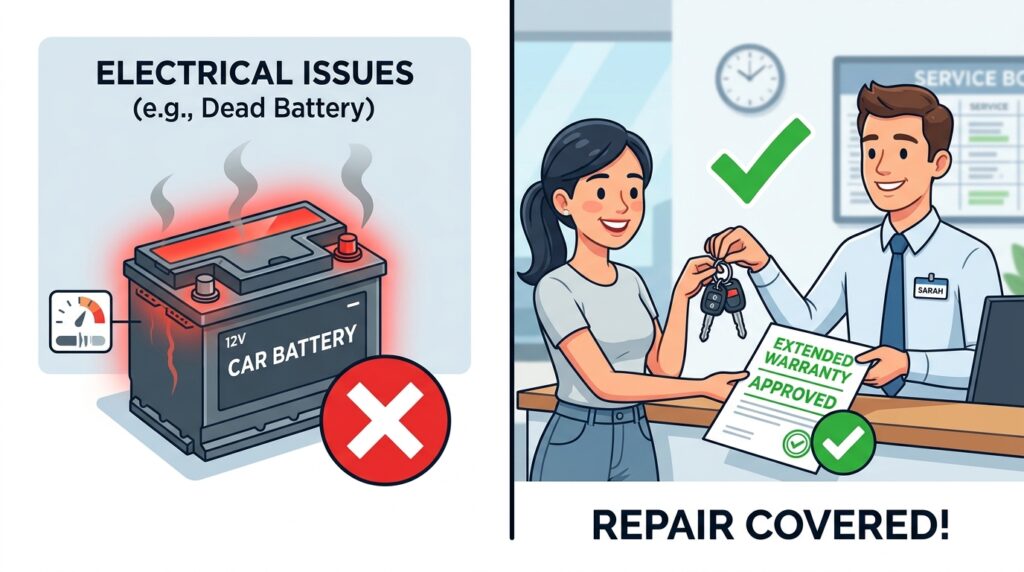
Batteries are almost always excluded because they are considered a wear item. They are designed to last only 3 to 4 years, so warranty providers treat them like oil or tires. Light bulbs, fuses, and spark plugs fall into the same category.
Pre-existing conditions are also excluded. If your car already has an electrical problem when you buy the plan, do not expect the warranty to fix it. The same goes for damage caused by accidents, water damage, rodent infestations, or improper maintenance.
Aftermarket modifications can also void your coverage for certain parts. If you have added custom wiring or upgraded electronics yourself, that could affect your claim for related electrical issues.
Why Electrical Repairs Are More Expensive Than You Think
Modern Cars Are Packed With Complex Electronics
Today’s cars are not just machines with engines. They are rolling computers. Modern vehicles use complex networks of sensors, wiring, onboard computer systems, and electronic control units that manage everything from engine performance to ABS brakes and airbag systems.
When something goes wrong with an electrical system, figuring out the cause requires specialized diagnostic equipment and trained technicians. That adds up fast. Unlike a flat tire or worn brake pads, electrical problems are often hidden and tricky to find without the right tools.
Real Cost of Electrical and Car Repairs in 2024 and 2025
To give you a real picture of what you are protecting yourself from, here is some data. According to insurance data analyzed by Kelley Blue Book using Mitchell’s Q1 2024 report, the average post-accident repair bill for a vehicle in the U.S. was around $4,703 for gas-powered cars. For electric vehicles with complex electrical architectures, that figure jumped to $6,066, a difference of nearly $1,400.
Even for regular gas cars, a single alternator replacement can cost between $300 and $700. An ECU replacement can run $800 to $1,500 or more. A broken power window motor might seem small, but parts and labor together can easily reach $200 to $400 per window. These are exactly the kinds of costs that a good extended warranty plan is built to protect you from.
How to Choose the Right Extended Warranty for Electrical Coverage
What to Look For in a Plan
When you are shopping for an extended warranty, do not just look at the price. Look at what the plan specifically says about electrical components. A plan that explicitly lists covered parts gives you a much clearer picture of what you are getting than a vague “comprehensive coverage” promise.
Here is what to check before you sign anything:
Read the exclusion clause carefully. This is the list of things NOT covered. If the exclusion list is short, that is a good sign. If it is long and includes lots of electrical parts, walk away or ask for a better plan. Ask if the plan covers wear and tear issues separately from mechanical failure. Most plans do not cover wear items, but it is worth asking.
Check the plan’s length and mileage restrictions. Some plans stop at 100,000 miles. If your car is already at 80,000 miles, you might only get a short window of coverage. Also, ask if the plan is transferable when you sell the car. A transferable warranty adds real resale value to your vehicle.
Comparing Third-Party Providers vs. Dealership Plans
You can buy an extended warranty from the dealership, directly from the manufacturer (OEM), or from a third-party provider. Dealership and manufacturer plans are often more expensive and come with stricter rules, like requiring you to use only their approved shops.
Third-party vehicle service contracts are usually more affordable and give you more freedom to choose your repair facility. Many also come with great extras like 24/7 roadside assistance, rental car reimbursement, and trip interruption coverage. Those perks can be really useful, especially if you drive a lot or travel long distances.
The Federal Trade Commission (FTC) recommends comparing multiple providers and reading every detail before committing to any extended warranty or service contract. That advice is spot on. I have seen too many people rush the decision and regret it later.
Tips for Handling Electrical Issues Outside Your Warranty
What to Do When You Have No Coverage
If your warranty has expired or does not cover the electrical problem you are dealing with, the first step is to get a proper diagnosis from a qualified automotive technician. Do not guess. Electrical problems are sneaky and guessing can make things worse and more expensive.
Once you have a clear diagnosis, get at least two or three quotes from different repair shops. Prices can vary a lot. Also ask if aftermarket parts or specialist repair facilities might offer a more affordable option. Some electrical repairs, especially for older cars, can be done much cheaper at an independent shop vs. a dealership.
When It Makes Sense to Get an Extended Warranty
Honestly, the best time to think about an extended warranty is before your factory coverage runs out. Once a problem shows up, it is usually too late. Pre-existing conditions are almost always excluded from coverage.
An extended warranty makes the most sense if you plan to keep your car for many years, if your car has a history of electrical problems, if you drive a lot of miles each year, or if your car is packed with expensive tech like advanced driver assistance systems (ADAS), LED headlights, or large infotainment displays. These systems cost real money to fix when they break.
Conclusion
So, does an extended warranty cover electrical issues? Yes, many do. But how much depends entirely on the type of plan you choose. A basic powertrain warranty will leave most of your car’s electronics unprotected. A bumper-to-bumper or exclusionary plan gives you the most coverage for electrical components like the ECU, sensors, power windows, starter, and alternator.
The key is to read the fine print, compare providers, and know what is and is not covered before you sign. Car electrical systems are only getting more complex and more expensive to fix. Having the right plan in place can save you hundreds or even thousands of dollars down the road.
I would love to hear your experience. Have you ever had an electrical issue covered or denied by your warranty? Drop a comment and let others know what worked for you.
Frequently Asked Questions (FAQs)
1. Does an extended warranty cover electrical issues like power windows and door locks?
Yes, but only if you have a mid-level or comprehensive plan. Basic powertrain warranties do not cover power windows, power door locks, or power seat motors. These are usually included in higher-tier plans that list them as covered electrical components. Always read the contract to confirm before buying.
2. Will an extended warranty cover a bad alternator or starter motor?
In most cases, yes. The alternator and starter motor are considered non-wear electrical parts and are included in most mid-range and comprehensive extended warranty plans. However, they are generally not covered by a basic powertrain-only plan. Always confirm with your provider before assuming.
3. Are car batteries covered under an extended warranty?
Usually not. Car batteries are considered wear items because they are only built to last three to four years. Most extended warranty providers exclude them from coverage for that reason. Electric vehicle owners may find specialized EV plans that offer some battery protection, but even those often come with limits and conditions.
4. Can I get an extended warranty for an older high-mileage car that covers electrical issues?
Yes, but your options may be more limited. Some providers do cover older cars with higher mileage, but the cost is usually higher and the coverage may be more restricted. Some providers may also require a vehicle inspection before offering coverage. Shop around and compare multiple providers to find the best plan for your situation.
5. What should I do if my extended warranty denies my electrical repair claim?
Start by contacting your warranty provider’s customer service department and asking for a clear explanation in writing. Review your contract to check if the part should be covered. If you still disagree, you can escalate the complaint or file a report with your state’s insurance regulator or consumer protection office. The Federal Trade Commission also has resources to help consumers deal with warranty disputes.