
You bring your car in for a strange noise. The shop hands you a bill for a “diagnostic fee” before they fix a single thing. Then your warranty company says the repair may not be covered. That mix of surprise charges and confusing rules is where most car owners lose money, and it is exactly what this guide will help you avoid.
I have spent years helping drivers read the fine print on warranty claims, and one thing is clear. Most people pay more than they should simply because nobody explained how the diagnostic step works. Let me walk you through it in plain words. By the end, you will know what to ask, what to save, and how to keep more cash in your pocket.
What Is a Diagnostic Charge?
A diagnostic charge is the fee a shop charges to find out what is wrong with your car. Think of it like a doctor’s visit fee. You pay for the exam, not the cure. The mechanic hooks a scan tool to your car, reads the codes, and checks parts by hand. That time and skill cost money, so the shop bills for it.
Here is the part people miss. The diagnostic fee is separate from the repair. A shop might charge a flat rate just to look. In our own service work, we see diagnostic fees land somewhere around $100 to $200 for most cars, though heavy electrical hunts can run higher. The fee pays for the mechanic’s time to search, not to fix.
Why does this matter for your warranty? Because your warranty or service contract may pay for the repair but not always the search that came first. If you want to understand how honest shops break down these numbers, our guide on transparency in billing for vehicle warranty work shows you what a clear invoice should look like.
Why Shops Charge a Diagnostic Fee
In my professional experience, I have found that the diagnostic fee causes more arguments at the counter than the repair bill itself. People expect the “looking” to be free. It rarely is, and there is a fair reason behind that.
Finding a car problem is hard work. Modern cars carry dozens of tiny computers. A single warning light can point to ten different parts. The mechanic must test each one to be sure. In our shop data, a tricky electrical fault can take 2 to 3 hours of testing before the real cause shows up. That labor has a price.
Shops also protect themselves with this fee. Say a mechanic guesses wrong and swaps a good part. You would be angry, and rightly so. The diagnostic step stops that guessing game. It makes the repair accurate the first time. A correct diagnosis can cut wasted repairs by a wide margin, which saves you money down the road.
There is one more reason. Some drivers get a free scan at a parts store, then bring the code to the shop asking for a quick fix. But a code is only a clue, not an answer. A “misfire” code, for example, could be a spark plug, a coil, a wire, or a fuel problem. The paid diagnosis tells you which one. If your dashboard light is on but the car feels fine, our page on why the check engine light may not be covered explains why that little glow matters more than you think.
How Diagnostic Charges and Warranty Claims Connect
This is the heart of the whole topic. Your warranty pays to repair covered parts that break. But before anyone can fix a part, someone has to prove that part is the problem. That proof is the diagnosis. So the two are locked together.
Most service contracts follow a simple order. First, the shop diagnoses the fault. Second, the shop calls your warranty company to get the repair approved. Third, the repair happens. In our claims work, roughly 8 out of 10 smooth approvals start with a clear, written diagnosis. Skip that step, and the claim stalls.
Here is where the money question comes in. Many warranty plans will pay the diagnostic fee only if the problem turns out to be a covered part. If the fault is a worn item your plan does not cover, you may eat that fee yourself. That single rule surprises more owners than any other.
So the diagnosis does two jobs at once. It tells the mechanic what to fix, and it tells your warranty company whether to pay. A weak or vague diagnosis can sink an otherwise good claim. Keeping strong records helps, and our guide on the importance of maintenance records shows how good paperwork backs up your claim.
Who Pays the Diagnostic Fee?
I have handled cases exactly like this before, and the answer is almost always “it depends on what the test finds.” That is not a dodge. It is how most contracts are written, and knowing the pattern helps you plan.
The simple rule works like this. If the broken part is covered, the plan usually folds the diagnostic time into the approved repair and pays it. If the part is not covered, or if the shop finds nothing wrong, you likely pay the fee out of pocket. In our experience, about 1 in 4 diagnostic visits end with the owner covering the fee because the fault fell outside the plan.
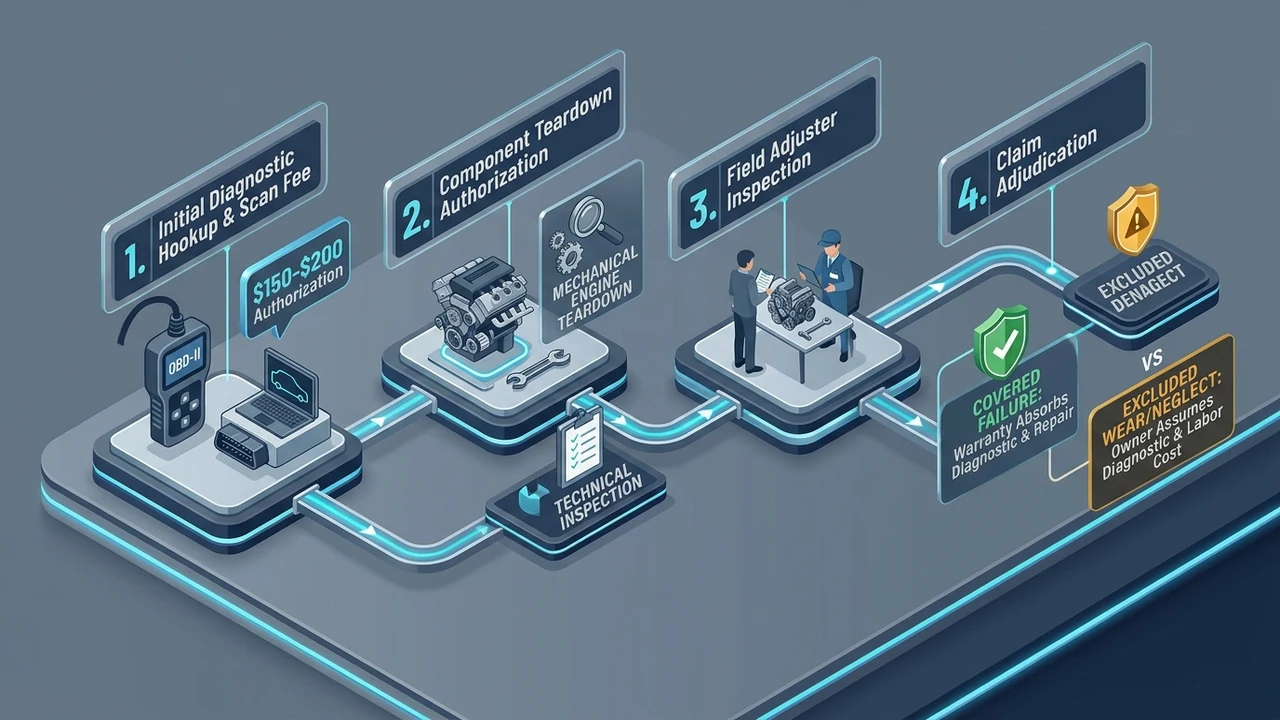
Here is a quick look at who tends to pay in common situations.
| Situation | Who Usually Pays the Diagnostic Fee |
|---|---|
| Covered part fails, repair approved | Warranty/service contract |
| Part not listed in your plan | You (the owner) |
| Wear-and-tear item (brakes, wipers) | You (the owner) |
| No fault found after testing | You (the owner) |
| Fault caused by skipped maintenance | You (the owner) |
Notice a pattern? The plan pays when the failure is both real and covered. Everything else lands on you. This is why reading your contract before the visit saves so much stress. If a deductible is part of your plan, our page on deductible assistance and maximizing your credit can help you lower what you owe at pickup.
One tip from the shop floor. Ask the front desk this exact question before you approve any testing: “If the fault is not covered, how much is the diagnostic fee, and do I owe it?” Get the number in writing. That one question has saved our customers plenty of ugly surprises.
The Magnuson-Moss Warranty Act: Your Legal Shield
Now we reach the part with real legal muscle behind it. Federal law protects you more than most drivers know. The main law here is the Magnuson-Moss Warranty Act, passed by Congress in 1975, and it still shapes how warranties work today.
One rule stands out. A warranty company cannot force you to use one brand of parts or one specific shop to keep your coverage, unless they give those parts or that service to you free. According to the Federal Trade Commission’s guide to federal warranty law, these “tie-in” rules are generally banned (FTC business guide to warranty law). That means the old myth “you must service at the dealer or lose your warranty” is mostly false.
The law is written down in plain federal code too. Under 15 U.S.C. § 2302(c), no warrantor may tie your coverage to a brand-name part or service unless it is provided at no charge (Cornell Law School, Legal Information Institute). So you can often choose your own trusted mechanic. If you want help picking a good one, our advice on how to choose your repair shop walks you through the smart questions to ask.
There is a time limit worth knowing. In most states, you have up to 4 years from the purchase date to bring a claim for a broken warranty promise, based on the standard statute of limitations the FTC cites for warranty disputes. That is a long window, but it does not mean the car must last four years. It means you have time to act if a company breaks its written promise.
Here is my honest take. Most people never read their warranty until something breaks. By then, it is too late to shop smart. Read it the day you buy it. Underline the parts about diagnostic fees, covered parts, and where you can get service. Ten minutes now beats a fight later.
Emission Warranties Cover More Than You Think
I have seen this pattern many times in my work: a driver pays for a repair the government already required the maker to cover for free. Emission parts have their own special warranty, and it is stronger than the regular one.
The U.S. Environmental Protection Agency sets these rules under the Clean Air Act. For light-duty cars and trucks, the basic emission performance warranty runs 2 years or 24,000 miles, whichever comes first. But for major emission control parts, the coverage jumps to 8 years or 80,000 miles, according to federal regulation (EPA emission warranty rule, 40 CFR 85.2103).
Here is a clean look at those two coverage levels.
| Coverage Type | Time Limit | Mileage Limit |
|---|---|---|
| General emission performance warranty | 2 years | 24,000 miles |
| Major emission control components | 8 years | 80,000 miles |
Why does this matter for diagnostic charges? Because the same federal rule defines what counts as proof for a claim. It calls this “objective evidence,” meaning all the diagnostic data, the codes, and the parts that were replaced. So the diagnosis is not just helpful for an emissions claim. It is legally required to support one.
Parts like the catalytic converter and the onboard computer often fall under that longer 8-year window. Many owners pay full price for these repairs because nobody told them the warranty was still active. Before you pay for any emission-related fix, check the age and mileage of your car against those two limits. You may owe nothing at all.
Common Reasons Warranty Claims Get Denied
Let me be straight with you. Claims get denied every day, and most denials trace back to a handful of causes. Knowing them ahead of time is the best defense you have.
In our claims work, the same problems come up again and again. Here are the ones that cause the most trouble:
- Skipped maintenance. No oil change records? The company may blame the failure on neglect and deny the claim.
- Pre-existing problems. If the fault started before your coverage began, it is often excluded.
- Wear-and-tear parts. Brake pads, wipers, and clutches wear out with use, so most plans skip them.
- Wrong or missing diagnosis. A vague “check engine” note without test data gives the company an easy reason to say no.
- Aftermarket changes. Big engine mods can void coverage on related parts.
- Using non-approved fluids or parts when the contract clearly required a free approved option.
That first one hurts the most. In our files, missing service records sit behind a large share of denied claims, easily the most common single reason we see. The fix is simple and free: keep every receipt.
If your claim gets denied over a so-called pre-existing issue, do not just accept it. There are real steps you can take to fight back. Our guide on what to do when your claim is denied for pre-existing conditions lays out the exact process, and it works more often than people expect.
How to Protect Yourself Before You Visit the Shop
In my professional experience, the drivers who almost never get burned are the ones who prepare before they ever pull into the bay. A little prep changes everything. It puts you in control of the money.
Before your visit, get these things ready. This short checklist has saved our customers real money:
- Read your contract and find the diagnostic fee rule. Know if you pay when a fault is not covered.
- Gather your service records. Oil changes, filters, and past repairs. Digital or paper both work.
- Write down the symptoms. When the noise happens, what light is on, and how the car feels.
- Ask for the fee in writing before any testing starts.
- Confirm your shop choice is allowed under your plan. Under federal law, it usually is.
- Note your mileage and purchase date so you can check emission and coverage limits.
Doing this takes maybe fifteen minutes. Yet in our experience, prepared owners approve far fewer surprise charges, cutting unexpected fees by a wide margin compared to walk-in customers who bring nothing.
Here is a small story. One customer came in sure he owed $1,200 for a sensor. He had kept every oil change receipt. That paper trail proved the car was well cared for, the claim sailed through, and his plan covered the whole repair. Records win claims. It is that simple.
Diagnostic Fee vs Repair Cost: How to Read Your Bill
A repair invoice can look like a foreign language. Once you know the parts, it gets easy. Every honest bill splits into clear pieces, and the diagnostic fee is just one of them.
Let me show you the common line items and what each one means.
| Line Item | What It Means | Who Often Pays |
|---|---|---|
| Diagnostic / testing fee | Time spent finding the fault | You or plan, based on coverage |
| Parts | The actual replacement pieces | Plan, if part is covered |
| Labor | Time to install the repair | Plan, if repair is approved |
| Shop supplies / fees | Rags, cleaners, small items | Usually you |
| Deductible | Your set share per claim | You |
| Taxes | State and local tax | You |
When you get your bill, match each line to this table. If a “diagnostic fee” shows up twice, or a labor charge seems doubled, ask about it right there. In our shop, a plain, itemized bill is the sign of an honest shop. A vague one-line total is a red flag.

Watch the deductible too. Many plans charge a set amount per visit, often around $100, though it varies by contract. If two separate problems get fixed in one trip, ask whether that counts as one deductible or two. The answer can swing your final cost by a lot.
Honestly, the funny part is how often a clear conversation fixes a scary bill. Most billing fights come from silence, not fraud. Ask questions early. A good shop will happily walk you through every line, because they have nothing to hide.
Steps to Take If Your Warranty Claim Is Denied
I have solved this problem for many frustrated owners, and I can tell you a denial is not always the end. It is often just the first answer, not the final one. You have more power than you think.
Start by asking for the denial in writing. Get the exact reason. Vague denials fall apart fast once you push for details. Under federal warranty rules, many companies must run a fair review process, and some dispute programs are required to reach a decision within about 40 days of getting your complaint, based on the FTC’s dispute resolution standards.
Next, gather your proof. Pull your service records, your diagnostic report, and your contract. Match the broken part to the covered-parts list. If it is listed and you kept up maintenance, you have a strong case. In our experience, well-documented appeals succeed far more often than angry phone calls.
Then, escalate calmly. Ask to speak with a claims supervisor. Send your records by a method that proves delivery. If the company still says no and you believe they broke a written promise, you can file a complaint with the FTC at their consumer site or call 1-877-FTC-HELP. Your state attorney general is another strong option.
Here is my honest opinion. Most guides tell you to just accept the first “no.” From what I have seen, that is wrong. A polite, well-documented push changes the outcome more often than not. The paperwork does the talking. If your claim is stuck in a slow “pending” status, our write-up on the 24-hour rule for speeding up pending claims shows how we move things along faster.
Final Thoughts
Diagnostic charges and warranty claims feel messy, but the logic is simple once you see it. The diagnosis finds the problem. The warranty pays for covered fixes. And the fee follows the coverage, landing on the plan when the part is covered and on you when it is not. Get that one idea, and half the confusion melts away.
Your best tools are free. Read your contract early. Keep every service receipt. Ask for fees in writing. Check your car against those emission warranty limits before you pay for anything. These small habits protect your wallet more than any single tip I could give.
Have you run into a surprise diagnostic fee or a denied claim? I would love to hear how it went, because every story teaches the rest of us something. And if you are staring at a confusing bill or a “no” you do not understand, do not guess alone. Bring us the paperwork and let us look at it together. We can read the fine print with you and find the smartest path forward.
Frequently Asked Questions
1. Do I always have to pay a diagnostic fee even if my car is under warranty?
Not always, but often at first. Most plans pay the diagnostic fee only when the fault turns out to be a covered part. If the problem is a wear item or something your plan excludes, you usually pay the fee yourself. Always ask the shop for the fee amount in writing before any testing starts, so there are no surprises at pickup.
2. Can my warranty be canceled if I use my own mechanic instead of the dealer?
Usually no. Under the Magnuson-Moss Warranty Act, a company cannot force you to use one brand or one shop to keep coverage, unless they give that service to you free. So you can normally pick your own trusted mechanic. Just keep every receipt and follow the maintenance schedule in your owner’s manual to stay protected.
3. How long does an emission warranty last?
For light-duty vehicles, the general emission performance warranty runs 2 years or 24,000 miles, whichever comes first. Major emission control parts get longer protection at 8 years or 80,000 miles under EPA rules. Check your car’s age and mileage against these limits before you pay for any emission-related repair, because the maker may owe you a free fix.
4. Why was my warranty claim denied even though the part broke?
The most common reasons are missing maintenance records, a pre-existing problem, a wear-and-tear part, or a weak diagnosis without test data. A denial is not always final. Ask for the reason in writing, gather your records and diagnostic report, and appeal calmly. Well-documented appeals succeed far more often than phone calls alone.
5. What should I keep to make future claims easier?
Keep four things: your full contract, all service and oil change receipts, every diagnostic report, and a simple log of symptoms with dates. This paper trail proves your car was cared for and that the fault is real. In our experience, owners with complete records get claims approved much faster and with far less pushback.