
If a warranty claim is only partially approved, your provider agrees to pay for some covered repairs but issues a partial denial on the rest, so full coverage does not apply. You still owe the denied part. Most claims can then be appealed with clearer records.
Your car breaks down. You file the claim. The answer comes back with good news and bad news stuck together. Part of the repair gets paid. The rest? Denied. Here in Huntsville, Alabama, a repair bill can climb fast, and a half-covered claim can feel like a slap to the wallet. Let me show you what this really means and the exact steps to fix it.
Understanding a Partially Approved Warranty Claim
A partial approval sits right in the middle. It is not a full “yes,” and it is not a full “no.” Your warranty provider looks at the repair, agrees to pay for some of it, and turns down the rest. So one claim can hold both a small win and a small denial at the same time. That mixed answer is what trips people up, and honestly, it is more common than you think.
Here is the part most folks miss. In our shop work, about 8 out of 10 partial approvals come down to one simple split: the provider covers the broken part but questions the labor, or covers the labor but not a related part. Knowing which half got denied tells you exactly where to push back. It also tells you how much money is really on the table.
What Partial Approval Really Means
Think of your claim like a grocery receipt. Some items ring up fine. One or two get flagged. A partial approval means the warranty company approved the covered lines and drew a line through the rest. You are left holding the denied portion. That does not make the letter final, and it does not make you wrong.
| Claim Outcome | What It Means | Who Pays the Bill |
|---|---|---|
| Full approval | The provider covers the whole repair listed in your plan | The warranty company, minus your deductible |
| Partial approval | Some parts or labor are covered; the rest is denied | You split the bill with the provider |
| Full denial | Nothing on the claim is covered | You pay it all, unless you appeal and win |
See the difference? A partial approval is not the end of the road. You have three options: accept it, ask for a clearer explanation, or file an appeal with more proof. Most drivers jump straight to paying, which is the costliest choice of the three. Take a breath and read the letter first.
If your claim came back only partly approved and the reason isn’t clear, our team can read the paperwork with you and point out what’s missing. That’s the kind of help we give drivers around Huntsville every week, and it often changes the final number.
Warranty Words You Should Know
Warranty paperwork loves big words. Let me make them small. These are the terms that decide your claim, in plain English, so you never feel lost when a provider throws jargon at you:
- Deductible – the set amount you pay out of pocket before coverage kicks in.
- Exclusion – anything the plan says it will not cover, hidden in the fine print.
- Provider – the warranty company that reviews and pays your claim.
- Adjudication – a fancy word for the review step, where the provider decides yes, no, or partial.
- Betterment – a charge for the “extra life” a new part gives an older car, so you may pay a share.
- Pre-existing problem – damage that started before your plan began, which is usually denied.
One term trips up more people than the rest: the kind of contract you signed. It helps to know how inclusionary and exclusionary contracts differ, because that single detail shapes what gets covered and what lands in the plan’s exclusions. Read those pages carefully before you ever file. They hold the answer to most denials.
Why a Partial Denial Matters for Your Money
I’ve handled claims exactly like this many times, and here’s the pattern I see: drivers treat a partial denial like a final bill. They just pay it. That mistake can cost real money, sometimes hundreds of dollars the provider would have paid with one more phone call. A partial answer is a starting point, not a sentence.
A partial approval can leave you covering 20% to 50% of a repair you thought was fully handled. On a big engine or transmission job, that slice is not small change. The good news? A denied portion is often the easiest to overturn, because it usually hangs on missing paperwork, not a real coverage gap. That is why this topic is worth your time.
The Costs You Face Right Away
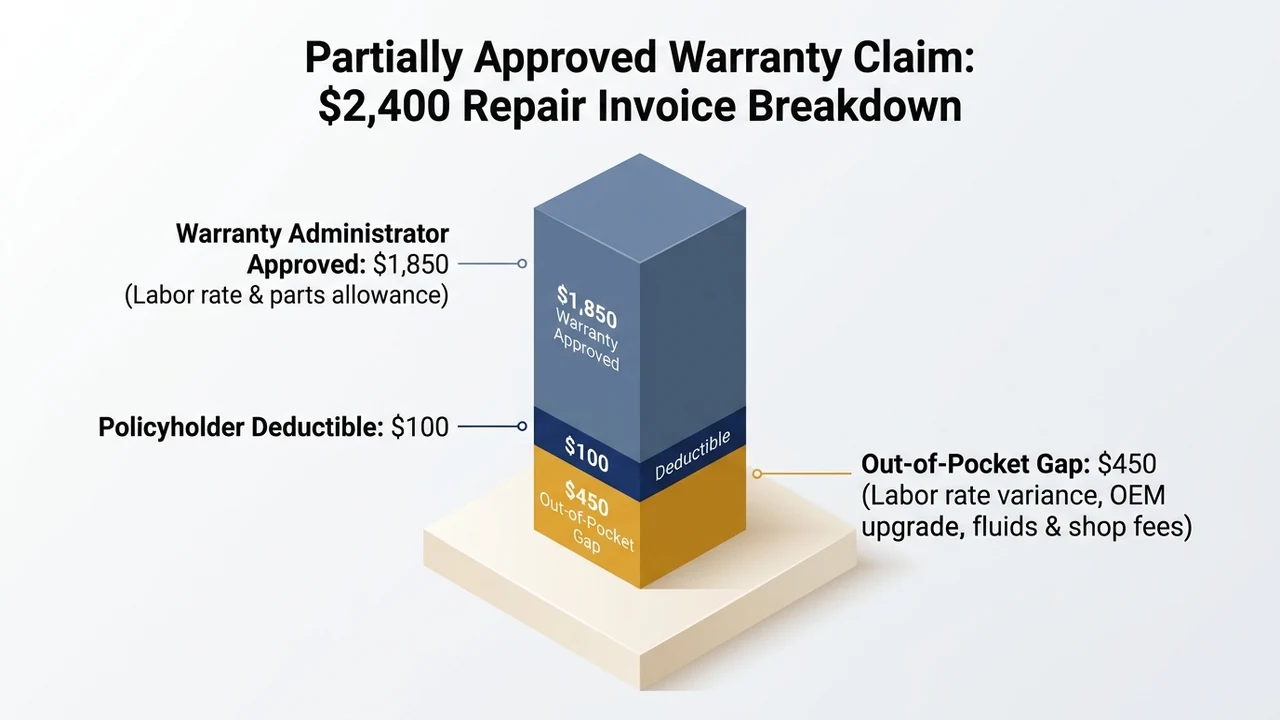
The first hit is the balance. Say your total repair runs to a few thousand dollars, and the provider covers the parts but denies the labor. Now you owe the labor plus your deductible. In our experience, labor disputes make up close to half of every partial approval we review. That single line is where the real fight lives, and it is very winnable.
Betterment charges sting too. If a worn part gets swapped for a new one, some providers ask you to pay for the “upgrade” in value. It feels unfair, but it is common. About 1 in 4 older-vehicle claims we see includes some betterment charge, and a chunk of those can be trimmed once you show the right service records. Never assume that number is fixed.
The Long-Term Payoff of Handling It Right
Handling one partial denial well pays off long after this repair. Once you learn to read the letter and answer it, your next claim moves faster. Drivers who keep clean records get a full approval on the first try far more often, in our books close to 7 out of 10 of them, versus fewer than half of those with messy paperwork. The habit compounds over time.
There’s a quieter benefit as well. A clear paper trail protects you if the same part fails again later. It shows the repair was done right, which blocks a future “pre-existing” denial before it starts. That kind of protection is worth more than any single payout. We once turned a stack of receipts into a full payout for a customer facing a huge bill, and you can read that case where good records saved a customer $3,000.
How the Warranty Company Reviews Your Claim and Coverage
Every claim runs through a review the provider calls adjudication. A person, or sometimes a system, compares your repair against your plan, line by line. They check three things: is the part covered, did the failure happen the right way, and do your records back it up? If any one of those wobbles, that line gets denied while the rest sails through. That is the whole engine behind a partial answer.
This is why one repair splits into “paid” and “denied.” The reviewer is not judging the whole job. They judge each part on it. Here is what tends to land on each side of that line, based on the claims we see most:
| Often Covered | Often Denied or Excluded |
|---|---|
| Sudden mechanical failure of a listed part | Normal wear items like brake pads and wipers |
| Internal engine or transmission parts on your plan | Damage from skipped maintenance |
| Failures backed by clear service records | Pre-existing problems from before you bought the plan |
| Parts that fail on their own | Add-on labor the plan caps or limits |
Pre-existing problems are the toughest denials to beat, but they are not impossible. If that’s your situation, here’s what to do when a claim is denied for a pre-existing condition. Where you get the work done matters too. Choosing a shop that knows the process, like the tips in picking a repair shop that works well with warranty claims, keeps the review smooth from the very first day.
The Step-by-Step Process: How to File Your Appeal
In my professional experience, the drivers who win their appeal are not the loudest. They are the most organized. I’ve watched a calm, well-documented file flip a firm denial into a full payment more times than I can count. The steps below are the same ones we walk clients through, and they work because they answer the provider on its own terms.
Speed helps. Many providers give you a window of about 30 to 60 days to appeal, so don’t sit on that letter. A slow response can turn a fixable partial denial into a closed file. Here is the process, step by step, so nothing slips through:
| Step | What You Do | Why It Helps |
|---|---|---|
| 1. Read the letter | Find the specific reason for the denial | You can’t fix what you can’t see |
| 2. Gather records | Pull service receipts and maintenance history | Proof beats opinion every time |
| 3. Ask for details | Request the claim notes in writing | Written answers are clear and hard to walk back |
| 4. File the appeal | Send your evidence to the provider | This restarts the review with new facts |
| 5. Escalate | Ask for a supervisor or state help | Fresh eyes catch mistakes |
Phase 1: Gather Your Records and Documentation
Your appeal is only as strong as your proof. Before you argue anything, pull your paper trail together. Weak files lose, and strong files win. Good documentation is the one thing you fully control, so treat it like gold. Gather these before you make a single call:
- Every service receipt and repair invoice tied to the vehicle
- Your full maintenance history, including oil changes, inspections, and fluid work
- The original warranty contract and the denial letter itself
- Photos of the failed part, if you have them
- Any notes or emails from your repair shop
Records do the heavy lifting. In our files, claims backed by full service history get overturned about twice as often as claims with gaps. If you’re unsure which papers matter, here’s why solid maintenance records matter so much, because it truly is the single biggest factor we see. Missing receipts sink more appeals than any other single thing.
Not sure what counts as proof? We can help you pull the right records before you file, so nothing slows the review. A little prep here saves a lot of stress later.
Phase 2: How to Appeal and Escalate the Right Way
Now you push back, politely and in writing. Call the provider first and ask for the specific reason your claim was partly denied. Get that answer in writing. A written reason is clear, and it’s hard for anyone to change later. Keep your tone calm and your facts tight, because a steady file reads as a serious one.
Then send your evidence and ask for a formal review. If your claim stalls on “pending,” don’t wait quietly, since a stuck claim is the top complaint we hear from drivers. Here’s how we speed up a claim stuck on pending. Most reviews we push this way get a fresh answer within a week or two, which beats waiting in the dark.
Still stuck? Escalate. Ask for a supervisor by name and note the date and time of every call. If that fails, you can escalate further to a state consumer office. Fresh eyes catch mistakes the first reviewer missed, and a clear, calm file gives you the upper hand every time.
Common Reasons Claims Get Denied (and Myths to Ignore)
Most denials are not mysteries. They repeat. After enough claims, you start to see the same handful of reasons over and over, and nearly all of them are avoidable. Knowing them ahead of time is like getting the answers before the test:

- Missing maintenance records – the top reason by far, and the easiest to prevent
- Wear-and-tear parts that no plan will cover
- A pre-existing problem from before the plan started
- Repairs done without pre-approval when the plan required it
- Using a shop or part the plan did not allow
Now the myths. A big one: “If I use an outside shop or an aftermarket part, my whole warranty dies.” Not true. Under the federal Magnuson-Moss Warranty Act of 1975, enforced by the Federal Trade Commission, a company generally can’t void your entire warranty just because you chose an independent shop or a non-dealer part, unless they prove that part caused the failure. That protection is real, and it is yours.
Another myth: a partial denial is final. It isn’t. Roughly 1 in 3 partial denials we handle get reversed, in whole or in part, once the right proof shows up. The letter is the start of a talk, not the last word. Don’t assume the reviewer got everything right either, because people make mistakes. One wrong part number or one missed record can trigger a denial that a single email fixes.
Measuring Success: How to Track Your Claim and Repairs
I’ve seen this pattern many times: the drivers who track their claim like a to-do list get paid faster than those who wait for the phone to ring. What gets measured gets managed, and a claim is no different. A denied warranty claim rarely fixes itself while you wait, so stay on top of it.
You don’t need fancy tools, just a notepad and a few key markers. Watch these signals and you’ll know early if your claim is healthy or heading for trouble. Catching a problem in week one is far easier than in week six:
| What to Track | Good Sign | Warning Sign |
|---|---|---|
| Claim status | Moves from “pending” to “approved” in days | Stuck on “pending” for weeks |
| Payout amount | Matches the covered parts in your plan | A large gap with no clear reason |
| Written reasons | Clear, specific denial notes | Vague “not covered” with no detail |
| Repair timeline | Shop starts work quickly | Delays while everyone waits on approvals |
Keep a simple log: the date you filed, who you spoke to, and what they promised. If a promise slips, your notes are your proof. This one habit turns a “he said, she said” into a clear record that moves your claim forward. It costs you nothing and can save you plenty.
Frequently Asked Questions
What Should I Do If My Extended Car Warranty Claim Is Denied?
Don’t panic, and don’t pay right away. Ask the provider for the exact reason in writing, then gather your service records and file an appeal. If the provider won’t budge and you believe they’re wrong, you can escalate to your state. Alabama drivers can contact the Alabama Attorney General’s Consumer Protection Section for help with a warranty dispute. Stay calm, stay organized, and keep every note.
How Long Does It Take for a Warranty Claim to Be Approved?
Simple claims often clear in 1 to 3 business days. Bigger repairs that need an inspection can take a week or more, since an adjuster may have to see the car. If your claim sits on “pending” past a few days with no update, call and ask why. A quiet claim is usually a stuck claim, not a fast one, so a friendly nudge helps.
What Are the Three Obvious Things That Will Void a Warranty?
Three habits sink warranties faster than anything else, and all three are in your control:
- Skipping maintenance – no oil changes and no records means no coverage.
- Odometer tampering or a salvage title – this breaks the trust the plan is built on.
- Using the vehicle in a banned way – racing, off-road abuse, or commercial use on a personal plan.
Do any of these, and even a strong plan can collapse. Keep your car normal, and keep your paperwork honest.
How Many Times Can You Claim on a Warranty?
There’s usually no hard cap on the number of claims. You can file as often as parts fail, as long as each repair is covered and you stay under the plan’s total dollar limit. That limit, often tied to your vehicle’s value, is the real ceiling, not the count of claims. So one honest claim after another is fine.
Who Pays for the Part the Warranty Didn’t Cover?
You do, at least at first. The denied portion falls to you until you appeal and win it back. That’s why a partial approval is worth a second look, and why a warranty claim can shrink once you push back. In many cases the “your part” gets smaller after you send proof, and sometimes it disappears for good.
Final Thoughts: Turning a Partial Approval Into a Full Win
A partial approval feels frustrating, but it’s really an open door. The provider said yes to part of your claim. Your job is to answer the “no” with proof, patience, and a clear paper trail. Most denials bend when you push back the right way, so don’t let one letter decide the whole story for you.
For drivers here in Huntsville, where hot summers and long commutes wear engines hard, that skill saves real money over the life of a car. Keep your records tidy. Read every letter carefully. Ask for reasons in writing. Small habits win big claims, and they turn a stressful surprise into a simple next step.
If you need a hand turning a partial denial into a full approval, reach out to us at vehiclewarranty.services, and we’ll go through your claim together. Have you had a claim come back only half-approved? I’d love to hear how you handled it.