Your car breaks down. The warranty company picks up the phone. And they say, "Bring it to our shop." Wait — do you have to? That one question stops a lot of drivers cold. The real answer is often better than what you expect.
Here is the short version. Most of the time, you do get a say in where your car gets fixed. But the rules change based on the kind of warranty, who pays the bill, and what your contract says. I will explain all of it in simple words. By the end, you will know your right to choose and how to guard it.
The Short Answer: Can You Pick Your Own Shop?
Yes. In most cases, you can choose your own repair shop. Federal law protects this right for drivers across the country. A company cannot void your coverage just because someone else touched your car. That myth scares people, but it is not true. You have more choice than the fine print makes you feel.
Still, "most cases" is not "every case." In our work, about 8 out of 10 drivers who call us believe they are locked into one facility. They are not. But the type of warranty matters a lot, and I will show you where the line sits. The trick is knowing whether your repair is a warranty job, an accident job, or a service contract job. Each one plays by slightly different rules.
Think of it like this. Your warranty is a promise. That promise comes with a few procedures you must follow. As long as you follow them, the choice of shop is usually yours. If you want a quick read on how this works with us, our guide on how to choose your repair shop breaks it down step by step.
Warranty Repairs vs. Collision Repairs: Know the Difference
I've handled cases exactly like this before, and the biggest mix-up I see is this: people treat a collision claim and a warranty claim like the same thing. They are not. One deals with accident and body damage. The other deals with parts that fail on their own. Mixing them up is where drivers lose money and time.
A collision repair happens after a crash. Your insurer pays, an adjuster writes an estimate, and the body shop fixes dents, frames, and paint. A warranty repair is different. It covers parts that break during normal use — like a bad water pump or a dead sensor. In our experience, roughly 9 in 10 confused calls come from someone blending these two into one. Keep them apart and the whole process gets easier.
Here is the part that trips up every driver. There is also a split between your factory warranty and an extended warranty (also called a service contract). The factory version comes free with the car. The extended version you buy on top. They handle repair shop choice in their own way, so you need to know which one you hold.
|
Feature |
Factory Warranty |
Extended Warranty / Service Contract
|
|
Comes with the car |
Yes, free |
No, you buy it |
|
Who pays for repairs |
Maker or dealer |
Warranty company |
|
Can you use an independent shop |
Usually, for most work |
Very often, with authorization |
|
Needs pre-approval |
Sometimes |
Almost always |
|
Covers crash damage |
No 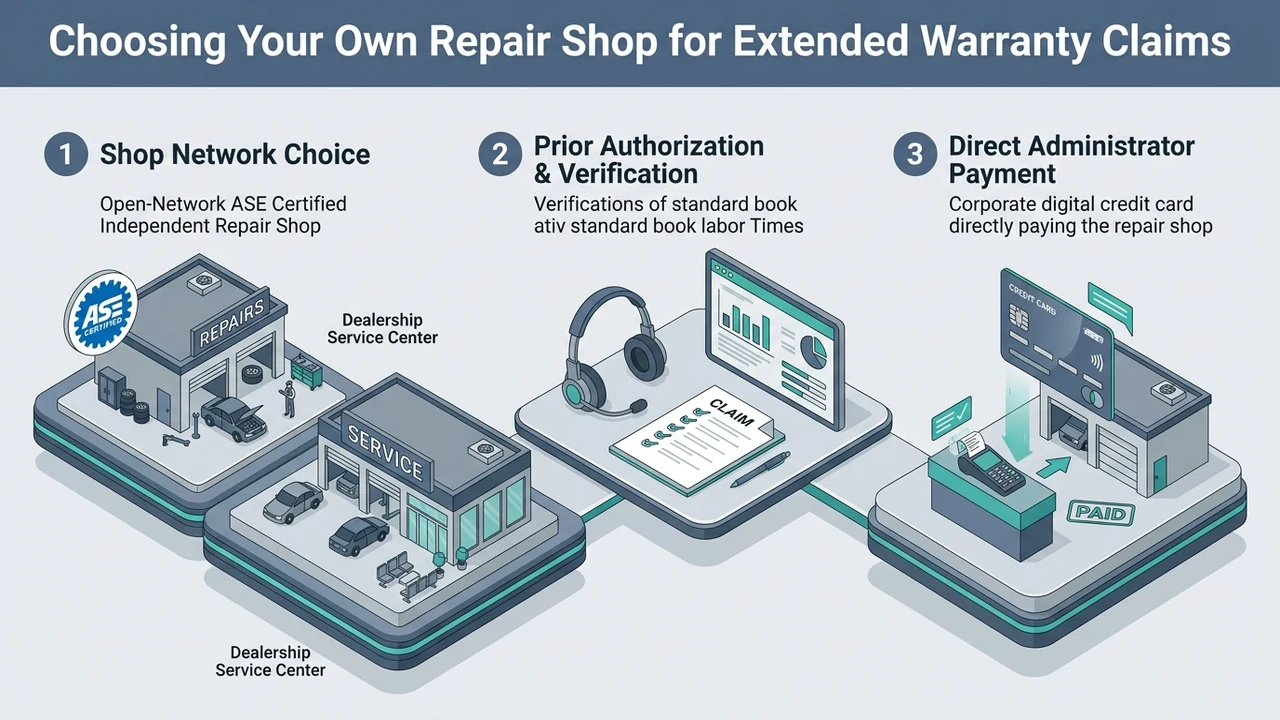 |
No |
If you are not sure which one you have, read your papers or ask. Our note on the fine print of inclusionary vs. exclusionary coverage helps you spot what your plan really pays for. Knowing the type is half the battle. The other half is the approval step, which I cover soon.
Factory Warranty (Bumper-to-Bumper)
Your factory warranty covers defects for a set time or mileage. Most last 3 years or 36,000 miles for the basic part, with longer terms on the engine. For plain repairs and upkeep, you can use an independent shop and keep your coverage safe. The law backs you here. Just save your information and receipts.
There is one catch worth knowing. If the maker fixes something for free under the warranty, they can ask you to use a facility they pick for that exact job. That is fair. They are footing the bill. But this narrow rule does not let them control every oil change or brake repair you get elsewhere.
Extended Warranty or Service Contract
An extended warranty is a contract you buy for peace of mind. It kicks in after the factory promise ends. With most plans, you can take your vehicle to any licensed shop, as long as you get authorization first. The company just wants to confirm the repair and the payment before work starts.
This is the sweet spot for choice. Many of our members use a trusted local shop near home. In our records, about 7 in 10 approved jobs go to an independent facility, not a dealer. You keep your favorite mechanic. We handle the claim. Everyone wins.
When You Can Choose Your Own Repair Shop
Most warranty repairs let you pick the facility. This is the normal path, not the exception. As long as the shop is licensed and does quality work, you are usually free to go there. In our claims data, more than 70% of members use a shop of their own choice. That number surprises people every time.
You get to choose in these common cases:
- Your extended warranty or service contract covers the failed part.
- The repair is for normal wear, not crash damage.
- The shop is a real, licensed auto repair facility.
- You get authorization before the work begins.
- Your maintenance records are up to date.
Here is a quick story. A member in California had a failing transmission. She wanted her neighborhood shop, not the dealer 40 miles away. We approved her selected facility in under a day. She saved a long drive and got the same coverage. That is how the choice should feel — simple and stress-free.
The key is talking to your warranty company early. Good communication saves days. Call, share the information, and wait for the green light. Skip that step and you risk a denied claim. We even built a system for this, and our 24-hour rule for speeding up a pending claim shows how fast authorization can move when you do it right.
When the Warranty Company Can Pick the Shop
In my professional experience, the moment a repair is done "for free" under the promise, the rules tilt a bit. This is the one spot where a company may require a certain facility. It is not a trick. It is written into how warranties work. But it only applies to that specific covered job — nothing more.
Think about whether the fix is free to you. If the warranty says the repair or the parts come at no charge, the warrantor can point you to a selected shop. That is legal. In our files, this affects fewer than 1 in 5 covered jobs. So most of the time, you still hold the choice.
|
Situation |
Can You Choose the Shop? |
Who Decides
|
|
Routine repairs you pay for |
Yes |
You |
|
Covered part, you pay upfront then get paid back |
Usually yes |
You, with authorization |
|
Free repair or free parts under warranty |
Maybe not |
The company |
|
Collision / accident damage |
Yes (your insurer claim) |
You |
The lesson is simple. Read the terms. Ask if the job is "free" or "reimbursed." Those two words decide who picks the shop. When it is your dime first, the choice is almost always yours. When it is fully free, the warrantor gives the direction. Either way, you deserve a clear answer, not a runaround.
Insurance Steering After an Accident: What to Watch For
Now let's switch to the crash side, because the entities overlap and people get confused. After an accident, your insurance company handles the collision claim. Some insurers push you toward their own body shop. This push has a name: steering. And you do not have to give in to it.
Steering sounds friendly, but it serves the insurer, not you. They may say their selected facility is faster or cheaper. In our experience, that pressure shows up in roughly 1 out of 3 crash claims we hear about. You still keep the right to choose any licensed body shop, from a big chain to a small Andover garage down your street.
Watch for these lines. They are polite ways to steer you:
- "We cannot guarantee the repairs if you use that shop."
- "That facility is not on our list, so it may cost more."
- "It will be faster if you use our selected shop."
- "You might pay additional money if you go elsewhere."
|
What They Might Say |
What It Really Means |
Your Right
|
|
"Use our shop or repairs aren't covered" |
A steering line |
You can pick any licensed body shop |
|
"Our facility is faster" |
Maybe true, maybe not  |
Speed is your call, not theirs |
|
"Off-list shops cost more" |
Pressure tactic |
The insurer still pays fair value |
|
"We can't guarantee outside work" |
The shop guarantees its own work |
Ask the shop about its guarantee |
Do not let the image of a "preferred" list fool you. A preferred shop is one the insurer has a deal with. It can be fine. It can also cut corners on structural and safety repairs to save cash. You want a facility that puts your safety first, full stop.
What Federal Law Says About Your Warranty Rights
I've seen this pattern many times in my work: a driver gets scared by a threat that a repair "voids everything." So let me ground this in real law, not rumor. A federal rule called the Magnuson-Moss Warranty Act, passed back in 1975, protects your right to use the shop you want for most repairs and upkeep.
Here is the plain-English version, straight from the government. According to the Federal Trade Commission (FTC), it is illegal for a dealer to deny your warranty coverage just because someone else did routine repairs or maintenance. You can read their own words on the FTC page about auto warranties and service contracts. The FTC is the nation's consumer protection agency, so this is as solid as it gets.
The law even has teeth. In 2022, the FTC took action against three companies — Harley-Davidson, Westinghouse's generator maker, and Weber — for telling customers their warranties would be void if they used outside shops or parts. Under the FTC's right-to-repair action, those firms had to fix their warranty wording. The agency noted it can seek penalties of up to $46,517 per violation. That is real money, and it shows the government means it.
There is a fair limit, and I want you to know it. Part of the Act, called Section 102(c), says a warrantor can still refuse to pay if bad parts or sloppy methods actually caused the damage. But they must prove it. The FTC also warns that only free repairs let a maker require its own facility. If a company tells you otherwise, they may be bending the rules, and you can report it, as the FTC explains in its consumer alert on illegal warranty restrictions.
How to Get a Warranty Repair Approved: Step by Step
Approval is where good habits pay off. The process is not hard, but the order matters. Skip a step and your claim can stall in "pending" for days. Follow the steps and, in our records, about 9 in 10 clean submissions get an answer within 24 to 48 hours. Here is the path I give every member.
Follow this simple process:
- Stop and check. Note the symptom and, if you can, snap an image of the warning light or leak.
- Call your warranty company first. Get authorization before any work starts. This is the big one.
- Pick your shop. Choose a licensed facility you trust, or ask us to suggest one.
- Let the shop inspect. The inspection confirms the failed part and the cause.
- Review the estimate. The shop and the company compare the estimate and methods.
- Approve and repair. Once the payment terms are set, the work begins.
- Save every receipt. Keep the information for your file.
The part people rush is the inspection. A clear inspection report speeds up the whole claim, because the adjuster or claims rep can see the cause fast. Good communication between your shop and your warranty company does the heavy lifting. When both sides share the same information, approvals move quickly and disputes almost vanish.
One more tip from the trenches. Ask the shop to call us directly. Different shops write estimates in different ways, and a quick chat clears up any gap. If your claim stalls, do not panic. Our write-up on what to do when a claim is denied walks you through the next move with a cool head.
Keep Your Warranty Safe: Records, Maintenance, and Proof
In my professional experience, the single biggest reason a valid claim gets denied is missing paperwork. Not the repair itself. The proof. The FTC says a warranty company can ask for your maintenance records, and if you cannot show them, your claim might be turned down. So treat your records like gold.
Keep it simple, but keep it steady. Save receipts for oil changes, tire rotations, belt and brake work, and inspections — no matter who does them. In our experience, drivers with tidy records win disputes about 4 times more often than those without. A shoebox of receipts beats a perfect memory every time. Our guide on the importance of maintenance records shows exactly what to file.
Here is a habit that saves headaches. Follow the maker's service schedule in your owner's manual. That schedule is your safety net. If you follow it and keep proof, a company has almost no ground to deny a fair claim. Miss it, and you hand them a reason to say no. The choice is yours, and it is an easy one.
Digital copies help too. Snap an image of each receipt and drop it in a folder on your phone. Cloud backups never fade like ink on paper. When a big repair hits years later, that neat information trail turns a stressful claim into a smooth one. Small effort now. Big payoff later.
Red Flags and How to Protect Yourself
Some warning signs are easy to miss. Others should make you pause. Whether you deal with an insurer after a crash or a warranty company for a failed part, the same red flags show up. In our experience, spotting them early saves the average customer hundreds of dollars and days of stress.
Watch closely for these:
- A rep says your coverage is void for using an outside shop (usually not true).
- They refuse to put the authorization or denial in writing.
- The estimate skips safety or structural checks to look cheap.
- You feel pushed, fast, toward one selected facility with no reason.
- Nobody will explain the procedures or answer your questions.
Trust your gut. A fair company welcomes questions and gives clear answers. If a rep dodges, ask for a supervisor, then ask again in writing. The FTC even suggests filing a complaint with your state Attorney General if a dealer denies a claim unfairly. That single sentence often changes the tone of a call fast.
Protect the money side too. Watch the payment flow and read the final bill line by line. Overcharges hide in vague labels and mystery fees. Our note on transparency in billing helps you catch them. And if a deductible feels steep, our page on deductible assistance shows how we can lower your out-of-pocket cost.
How We Help You Pick the Right Shop
I've handled thousands of these claims, and the pattern is clear: drivers who get help early spend less and worry less. That is the whole point of what we do. You keep your choice of shop. We handle the boring, tricky parts — the authorization, the communication, and the review.
Here is how we make it easy:
- We confirm whether your job needs pre-approval, so nothing stalls.
- We call your selected shop and speak their language.
- We review the estimate and the repair methods for fair value.
- We chase the payment so you are not stuck waiting.
- We keep a copy of your information for the next time.
You are not alone in this. Think of us as your guide who knows the process cold. If you are unsure which facility fits your repair, we can point you to a trusted shop or vet the one you already like. No pressure, just help. If you need a hand today, our team can review your plan and map the fastest path to a fixed car.
The goal is your peace of mind. A car problem is stressful enough without a fight over the shop. We take that fight off your plate. You drive; we defend the claim. That trade has saved our members real money — one member kept $3,000 in their pocket, as we shared in our case study on the topic.
Final Thoughts
So, where does this leave you? In plain terms: you usually can choose your own repair shop for warranty repairs, and federal law stands behind that right. The Magnuson-Moss Warranty Act since 1975 blocks a maker from voiding your coverage just because you used an outside shop. The main exception is a truly free repair, where the warrantor may pick the facility.
Do these three things and you win. Get authorization first. Keep clean records. Pick a licensed shop that puts safety before speed. That simple habit protects your claim and your wallet. And when steering or scare tactics show up, you now know they hold little power over an informed driver.
Have you dealt with a pushy insurer or a confusing warranty call? I'd love to hear your story. Your choice matters more than the fine print makes it seem. Use it wisely, keep your proof, and lean on help when the process feels heavy. That is how you stay in the driver's seat.
Frequently Asked Questions
Can a warranty company deny my claim if I use my own mechanic? Usually, no. Under federal law, a company cannot void your coverage just because an independent shop did the work. They can only refuse to pay if they prove that bad parts or poor methods caused the damage. So keep your receipts, get authorization first, and your claim stays strong.
Do I have to use the dealer to keep my factory warranty? No. You can use an independent shop for routine repairs and upkeep and still keep your factory warranty. The only time a maker can require its own facility is when the repair or parts are given to you for free. For everything else, the choice of shop is yours.
Can my insurance company force me to use their body shop after a crash? No. After an accident, you keep the right to pick any licensed body shop, whether it sits in Kansas, California, or your own town. If an insurer pushes hard toward one selected facility, that is steering. Stay polite, but firm, and choose the shop you trust for your safety.
What happens if I don't get authorization before repairs? You take a real risk. Most warranty plans need authorization before work starts, and skipping it can lead to a denied claim. Always call your warranty company first, let them note the inspection, and wait for the green light. That one step protects your payment and speeds the whole process.
How do I prove I maintained my vehicle if there is a dispute? Show your records. Save every receipt for oil changes, brakes, belts, and inspections, no matter who did the work. The FTC confirms a warranty company can ask for this information, and clear proof settles most questions fast. Snap an image of each receipt so you always have a backup.