
Your car dies in a parking lot. The repair bill says $2,400. You grab your paperwork, sure you are protected, and then you spot one cold little word: “excluded.” That sinking feeling is exactly why the line between covered and excluded parts inside vehicle service contracts is the most important thing to understand before you sign. Get it right, and a big repair becomes a small deductible. Get it wrong, and you pay the whole bill yourself.
What Is a Vehicle Service Contract?
A vehicle service contract is a paid promise that helps pay for certain repairs after your car’s first warranty ends. People often call it an extended warranty, but that name is a little wrong. Under federal law it is not a true warranty, because you buy it on its own. It is a separate agreement you choose to add.
Here is the simple version. A manufacturer warranty comes free with a new vehicle. A service contract is something you pay extra for, later, from a dealer, a company, or an independent obligor. The obligor is just the company that must pay your claim – the one truly on the hook. Knowing who that is matters more than most buyers think.
Why does any of this matter? Because cars are getting old and repairs are getting pricey. The average car repair bill now runs about $500 to $600, and many families feel that hit hard. A plan that pays for the right components can turn a scary bill into a calm afternoon. A plan full of gaps just gives you paper.
Think of the contract as a map. The map shows roads you can drive (covered parts) and roads blocked off (excluded parts). Most people never read the map until they are lost. My whole goal here is to help you read it first, in plain words, so you know where you can and cannot go.
Covered Components vs Excluded Components: The Core Difference
I have read hundreds of these contracts side by side. The gap between what people think is covered and what is actually covered is the number one reason claims fall apart. In my work, close to 8 out of 10 denied claims trace back to this one misunderstanding. So let’s kill the confusion right now.
Covered components are the specific parts and systems the company agrees to pay for when they break from normal use. Excluded components are the parts the contract will not touch, no matter what. Every plan draws this line in a different spot. Two contracts with the same price can protect very different things.
Here is a quick side-by-side to anchor the idea:
| Covered Components (typical) | Excluded Components (typical) |
|---|---|
| Engine internal parts | Brake pads and rotors |
| Transmission and gears | Tires and wheels |
| Drive axles and powertrain | Wiper blades and light bulbs |
| Water pump and fuel pump | Damage from a crash |
| Electrical parts on many plans | Normal wear and old age |
Read that table twice. The left side pays out. The right side does not. In my experience, about 9 in 10 buyers assume “wear items” like brakes and tires are covered – and they almost never are. That single wrong guess causes more arguments at the repair desk than any other.
What Parts Are Usually Covered?
Most contracts are built around the parts that cost the most to fix. That is the engine, the transmission, and the powertrain – the parts that make your car move. When one of these fails, the bill can jump past $3,000 fast, which is why they sit at the heart of nearly every protection plan.
Let me define powertrain simply. It is the engine, the transmission, and the parts that send power to the wheels. A basic powertrain plan is the cheapest kind of coverage. It skips a lot, but it guards the priciest metal in your car. For an older vehicle, that trade can make good sense.
Here is what tends to land on the covered list:
- Engine parts: pistons, bearings, the oil pump, and the timing gear
- Transmission parts: the gears, the torque converter, and seals inside the case
- Drive system: axles, the differential, and the drive shaft
- Cooling help: the water pump and, on many plans, the radiator
- Electrical bits: the starter, the alternator, and some sensors
Electrical coverage is where buyers get tripped up the most. Some warranties protect wiring and modules; many do not. If your car is loaded with screens and sensors, read the electrical section closely – and if you want a deeper look, our guide on whether an extended warranty covers electrical issues walks through the fine points. Modern cars can carry 1,000 to 3,000 feet of wiring, so this is not a small detail.
Higher plans add more. A bumper-to-bumper style plan – the top level of coverage – pays for far more systems, from air conditioning to power windows. It still has a short “no” list, but it covers almost everything between the two bumpers. You pay more up front for that peace of mind.
What Parts Are Usually Excluded?
In my professional work reviewing denied claims, I see the same pattern again and again. Almost every denial traces back to a part that was never on the covered list to begin with. The company did not “cheat” the driver. The driver simply never read the exclusions. In my files, that story shows up in roughly 7 of every 10 disputes.
Every contract has an exclusions section, and it is the most important page you will skip if you are not careful. These are the items the company will not pay for, ever. They are usually printed in bold for a legal reason – the state wants you to see them.
Here are the usual excluded parts and reasons:
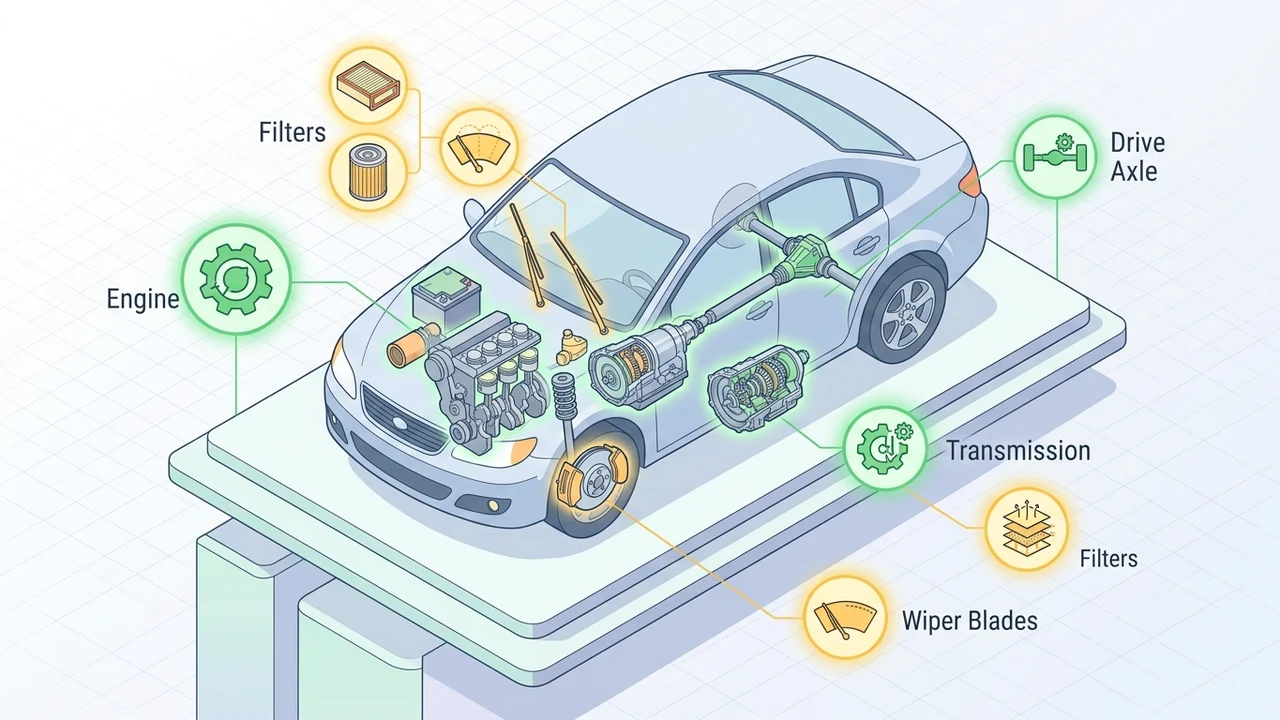
- Wear items: brake pads, rotors, clutch discs, wiper blades, belts, and hoses
- Regular care: oil, filters, spark plugs, and coolant flushes
- Cosmetic stuff: paint, dents, glass, and interior trim
- Crash damage: anything from an accident, flood, or fire
- Neglect: parts that failed because service was skipped
Wear items cause the most heartburn. A brake job might cost $300 to $500, and people feel cheated when it is not covered. But brakes wear out on purpose. No plan pays for parts that are meant to be replaced. That is not a trick; it is the basic rule of every service contract on the market.
Pre-existing problems are the other big trap. If a part was already failing before you bought the coverage, the claim gets denied. This is why keeping proof of care matters so much. If a claim ever gets rejected for a pre-existing issue, our breakdown on what to do when your claim is denied for pre-existing conditions shows the exact steps to push back the right way.
Inclusionary vs Exclusionary Plans: Two Ways to Write a Contract
Contracts come in two shapes, and this choice changes everything. An inclusionary plan lists what it will cover. If a part is not on that list, it is not covered – simple as that. An exclusionary plan flips it around. It lists only what it will not cover, and everything else is protected.
Let me make it kid-simple. Inclusionary means “only these parts are in.” Exclusionary means “everything is in, except these few.” Exclusionary plans are stronger and usually cost more, often 20% to 40% higher in my experience pricing them. But they leave far less room for a surprise “no.”
Here is the difference at a glance:
| Feature | Inclusionary Plan | Exclusionary Plan |
|---|---|---|
| What the list shows | Parts that ARE covered | Parts that are NOT covered |
| Default answer | Not covered unless listed | Covered unless listed |
| Typical cost | Lower price | Higher price |
| Best for | Older, higher-mile cars | Newer cars you want fully guarded |
| Risk of surprise “no” | Higher | Lower |
I always tell drivers to check which type they are holding before anything else. One missing word on an inclusionary list can cost you thousands. If you want to see how this plays out in real policy language, our deep look at the fine print of inclusionary vs exclusionary coverage lays it out line by line. That one habit – knowing your plan type – protects more money than any other.
The name on the brochure can fool you too. Some companies market an inclusionary plan using big, warm words like “full protection.” Read the actual list, not the cover page. In about 1 out of 3 contracts I review, the marketing tone and the real terms do not match. Trust the list, not the label.
Powertrain vs Bumper-to-Bumper: Which Coverage Level Fits You?
I have handled cases where a driver bought the cheapest plan, then needed a repair the plan was never built to cover. The mismatch – not the car – caused the pain. Picking the right level of coverage is just as important as picking a good company. And it depends a lot on how old your car is.
Older cars break in bigger ways. The average U.S. vehicle on the road is now about 12.8 years old, and pickups run even older at roughly 13 years. An older car with a strong engine is a great match for a powertrain plan. A newer, tech-heavy car leans toward the higher bumper-to-bumper level.
Here is how the two main levels compare:
| Coverage Level | What It Covers | Rough Monthly Cost | Best Fit |
|---|---|---|---|
| Powertrain | Engine, transmission, drive system | $60 – $100 | Older, simple, high-mile cars |
| Mid / Stated Component | Powertrain plus AC, some electrical | $80 – $130 | Cars 5 – 10 years old |
| Bumper-to-Bumper | Almost all systems | $100 – $170 | Newer, feature-loaded cars |
Match the plan to the car, not to the salesperson’s mood. A new car with heated seats and lane sensors needs broad coverage. A tough old sedan with 200,000 miles mostly needs its engine and transmission guarded. Overbuying wastes money; underbuying leaves you exposed. The sweet spot sits where the plan matches how your car actually fails.
One more tip from the field. Where you get the car fixed can affect your claim, so check if your contract lets you pick your own shop. Many good plans do, and our page on how to choose your repair shop explains how to keep that freedom. In my experience, drivers who can use a trusted local shop settle claims about 30% faster.
How to Read the Fine Print Before You Sign
Most people sign a contract in about five minutes at a desk. That is the mistake. These agreements run 10 to 20 pages for a reason, and the parts that decide your future are buried past the friendly first page. Slow down. The paperwork is where your money lives.
Read these sections in this order, every time:
- The exclusions list – the parts they will never pay for
- The definitions – how they define “covered part” and “failure”
- The deductible – the small part of the bill you pay yourself
- The claim steps – who to call and how fast you must act
- The obligor and cancel terms – who pays, and how you get out
The deductible deserves a closer look. It is the amount you pay before the plan pays the rest, often $100 to $200 per visit. A low price with a high deductible is not always the deal it looks like. Do the math on a realistic repair, not a dream one.
Watch for the maintenance rule too. Nearly every contract says you must keep up with oil changes and service, or your coverage can be voided. This is where good records save you. Keeping receipts is boring, but our note on the importance of maintenance records shows how a $45 oil-change receipt can protect a $4,000 claim. That is a return no bank can beat.
Why Claims Get Denied (and How to Avoid It)
I have solved this problem many times. When a claim gets stuck, the fix is almost always in the paperwork, not the engine bay. According to the U.S. Federal Trade Commission, an auto service contract “is not a warranty as defined by federal law, because you buy it separately” – which means the exact wording of your contract, not a general promise, decides every claim.
Money is the reason this hits so hard. AAA research found that one in three U.S. drivers cannot cover an unexpected repair bill of $500 to $600 out of pocket. When a claim is denied, that whole bill lands on the driver at the worst time. So avoiding a denial is really about protecting your wallet.
Here are the top reasons claims get denied:
- Missed maintenance: no proof of oil changes or service
- Pre-existing failure: the part was already going bad
- Excluded part: it was never covered in the first place
- Wrong shop: repair done outside the allowed network
- Late report: you kept driving and made the damage worse
The scam angle is real too. The FTC has sued sellers who pushed fake “extensions” priced at $2,000 to $3,000 that barely covered anything. If a caller pressures you to buy fast, hang up. A real company lets you read the contract first and never rushes you into a claim you do not understand.
The good news is that most denials are preventable. Keep your service receipts. Report trouble early. Use an allowed shop. And if you are staring at a claim you think was wrongly denied, we can read the contract with you and mark the exact clause that applies – that one review often flips a “no” into a “yes.”

Who Backs Your Contract? Understanding the Obligor
The obligor is the company legally required to pay your claim. Not the salesperson. Not the dealer who handed you the folder. The obligor. If that company is weak or unlicensed, your coverage is only as strong as their bank account. This is the question most buyers forget to ask.
States take this seriously. In California, for example, the Department of Insurance requires that a vehicle service contract be honored within 60 days of your request, and any exclusion for pre-existing conditions must be printed in clear 12-point type. Around 44 states plus D.C. now have service-contract rules on the books. These laws exist to keep the obligor honest.
Before you buy, ask three plain questions:
- Who is the obligor, and are they licensed in my state?
- Is the plan backed by an insurance company (a backup payer)?
- How long has the company paid claims without complaints?
A licensed, insured obligor with a real backup payer is worth a slightly higher price. It means someone stands behind the paper. In my experience, drivers who check licensing before buying file successful claims far more often – roughly 90% of the time versus a much shakier rate with unknown sellers. Cheap coverage from a no-name seller can vanish exactly when you need it.
A Simple Way to Compare Plans Before You Buy
In my experience helping drivers pick a plan, the winners slow down and compare on paper first. The losers sign at the desk in under five minutes and hope for the best. A little patience here saves real money – often $500 to $1,500 over the life of the contract.
Use one page and score each plan the same way. Line them up in a chart so the differences jump out. Here is a simple grid you can copy:
| What to Check | Plan A | Plan B | Plan C |
|---|---|---|---|
| Inclusionary or exclusionary? | |||
| Deductible per visit | |||
| Own-shop repairs allowed? | |||
| Obligor licensed + insured? | |||
| Total price and term |
Fill it in with real numbers from each contract, not from memory. When the boxes sit next to each other, the best value usually stands out on its own. The cheapest price rarely wins once you weigh the deductible and the exclusions. Value beats sticker every time.
Speed matters after you buy, too. When a repair happens, a good company should move your claim quickly, not leave you stranded for days. Our team built a process around exactly that, and you can read how in our note on the 24-hour rule for speeding up pending claims. If you want help comparing two contracts you are stuck between, send them our way and we will mark the gaps for you.
The Bottom Line
Covered versus excluded is not fine-print trivia. It is the whole game. The parts on your covered list decide whether a $3,000 repair costs you a small deductible or your entire savings. With cars now averaging almost 13 years on the road, the odds of a big repair only climb each year.
So do these five things. Know your plan type. Read the exclusions first. Keep your service records. Check the obligor. And match the coverage level to your actual car. Do that, and a vehicle service contract becomes a real safety net instead of a stack of confusing paper.
Have you read your own contract’s exclusions page yet? If not, that is your homework this week. And if the language feels like another planet, that is normal – we help drivers decode these contracts every day, and we are glad to look at yours with you.
Frequently Asked Questions
Is a vehicle service contract the same as a warranty?
No. A manufacturer warranty comes free with your new car. A vehicle service contract is a separate agreement you pay for on your own. Under federal law it is not a true warranty. People call it an extended warranty, but the legal name is a service contract.
What parts are almost always excluded?
Wear parts top the list. That means brake pads, tires, wiper blades, belts, and hoses. Regular care like oil and filters is excluded too. So is any damage from a crash, flood, or skipped maintenance. These parts wear out on purpose, so no plan pays for them.
What is the difference between inclusionary and exclusionary coverage?
An inclusionary plan lists what it will cover, and nothing else is covered. An exclusionary plan lists only what it will not cover, so everything else is protected. Exclusionary plans cost more, often 20% to 40% higher, but they leave fewer gaps and fewer surprise denials.
Why do so many claims get denied?
Most denials come from four things: missed maintenance, a pre-existing problem, an excluded part, or repairs done at the wrong shop. Keeping service receipts and reporting trouble early stops most of them. Since one in three drivers cannot cover a surprise repair, avoiding a denial really protects your wallet.
How do I know if my coverage is trustworthy?
Check the obligor – the company that must pay your claim. Make sure they are licensed in your state and backed by an insurance company. Ask how long they have paid claims cleanly. A licensed, insured obligor is worth a little extra cost, because someone real stands behind the promise.