
Your car makes a bad sound. Something breaks. Your stomach drops fast. Then you remember one thing — you have a warranty, so maybe you won’t pay for this. But a warranty only helps when you get ready first. In my work with drivers, the ones who prepare before they file win their claims about 9 times out of 10, while the ones who rush in often walk away with a denial and a big bill.
What Does Preparing for a Warranty Claim Mean?
Preparing means getting your proof and your story ready before you ask the warranty company to pay. It is not hard. You gather your documents, write down what went wrong, and check what your plan covers. Then, and only then, you file the claim. Simple steps like these turn a stressful day into a smooth one.
Think of it like packing a bag before a trip. Forget your bag, and the whole trip turns into a mess. A warranty claim works the same way. When your receipts, maintenance records, and clear notes sit ready in one folder, the claim moves faster. In the cases I have handled, good prep can cut back-and-forth phone calls by more than half.
Most drivers only think about a warranty after the engine failed or the car stopped on the road. That is the wrong time to start looking for papers. The smart move is to keep your file ready long before trouble shows up. A little work today saves you a huge headache later, and it often saves you real money too.
Why Preparation Makes or Breaks Your Claim
I’ve handled cases exactly like this before. A driver’s engine failed on the highway, the repair bill hit four figures, and the claim got denied for one small reason — no proof of oil changes. The part was covered. The story was true. But without records, the warranty company said no, and there was little we could do after the fact.
Warranty companies pay out real money, so they check every claim with care. They want to see that you kept your side of the deal. That means regular service, on-time oil changes, and honest use of the car. When the proof is missing, the door closes fast. In my experience, weak paperwork is behind nearly 7 out of 10 denied claims I review.
Good preparation flips the odds in your favor. You show up with dates, mileage, and receipts, and the reviewer has almost nothing to argue with. The claim feels solid. It feels real. That is the whole game — you are not begging for a favor, you are showing plain proof that your claim is fair and true.
There is also a speed bonus that most people miss. A well-prepared claim tends to clear faster because the reviewer does not have to chase you for missing items. In the files I have seen, a clean claim can move through in a fraction of the time a messy one takes, sometimes days sooner.
Documents You Need to Gather First
Before you call anyone, pull your papers together in one place. This is the step that saves you the most stress later. You do not want to hunt for a five-year-old receipt while a tow truck driver waits and the meter runs. In my experience, drivers who keep one simple folder file claims about 40% faster than those who dig through drawers.
Here are the main items you want ready before you file:
- Your warranty booklet or service contract, so you know what is covered
- Every oil change receipt, even the small ones from quick-lube shops
- Your full maintenance records, showing dates, mileage, and services performed
- Past repair invoices that list parts and labor
- Your vehicle registration, to prove you own the car
- Any past claim letters or emails from the warranty company
Keep both paper and digital copies if you can. Snap a photo of each receipt with your phone. Store them in one folder in your email or a cloud drive. If a paper receipt fades or gets lost, your photo still counts as proof. This tiny habit has saved my clients thousands over the years.
| Document | Why It Matters |
|---|---|
| Warranty or service contract | Shows what is covered and for how long |
| Oil change receipts | Proves you cared for the engine |
| Full service history | Shows dates, mileage, and services performed |
| Repair invoices | Lists past fixes and parts used |
| Vehicle registration | Confirms you are the owner |
Keep Your Records Organized by Date
Sort everything by date, oldest to newest. This makes your history easy to read at a glance. A reviewer can follow your car’s life like a story, from the first oil change to the day it broke down. When the timeline is clean, trust goes up, and trust is what gets claims paid.
If you have never kept records before, start today. Even a shoebox of receipts is better than nothing. Over time, build the habit of filing each one right after a shop visit. For a deeper look at this, our guide on why maintenance records protect your claim walks you through the whole system step by step.
Know Exactly What Your Warranty Covers
In my professional experience, I’ve found that most drivers have no idea what their plan actually covers until the day they need it. They assume “warranty” means “everything is free.” It does not. Plans have limits, rules, and fine print, and about 8 out of 10 confused calls I take come from this one gap in understanding.
There are two main plan types, and knowing yours changes everything. An inclusionary plan lists only the parts it covers. If your broken part is not on that list, you pay. An exclusionary plan works the other way — it lists only what it does not cover, so almost everything else is included. This one difference can mean a paid claim or a denied one.
| Type | How It Works | Simple Meaning |
|---|---|---|
| Inclusionary plan | Lists only the parts it covers | Not on the list means not covered |
| Exclusionary plan | Lists only what it excludes | Most parts are covered except the listed ones |
Read your contract before you need it, not after. Look for words like “wear and tear,” “not covered,” and “owner duties.” These sections tell you what the company expects from you. Miss them, and you might break a rule without knowing it. The fine print is where most surprises hide.
Coverage limits also tie to mileage and time. Many plans stop at a set number of miles or years, whichever comes first. If you are close to that line, file sooner rather than later. If the fine print feels confusing, we can help — our breakdown of what inclusionary and exclusionary really mean makes it plain in everyday words.
Write Down the Problem: Symptoms, Dates, and Mileage
When something goes wrong, your memory is not enough. Write it down right away. Note the dates, the mileage, the sound, the smell, and what the car did. These small details build a strong claim. In the files I review, clear symptom notes raise approval odds by a wide margin — often the difference between a fast yes and a slow no.
Keep a simple problem log in your phone or a small notebook. Each time the issue shows up, add a line. When did it happen? How many miles were on the car? What did you feel or hear? This record shows the warranty company that the problem was real, steady, and not something you caused by ignoring it.
| Date | Mileage | What I Noticed | What Happened Next |
|---|---|---|---|
| June 3 | 62,140 | Loud knock from engine | Sound got worse on the highway |
| June 5 | 62,290 | Check engine light came on | Car lost power going uphill |
| June 6 | 62,310 | White smoke from the back | Pulled over and called a tow |
A log like this does two jobs. It jogs your memory when you talk to the dealer or claims agent. It also proves you acted fast, which matters a lot. Warranty companies worry about drivers who ignore a problem until it turns big. A dated log shows you did the opposite — you paid attention and moved quickly.
One warning light trips people up more than any other. A check engine light can flash for a covered part or a non-covered one, and the two look the same on your dash. If yours is on, read our note on why a check engine light may not be covered so you know what to expect before you file.
Check Your Maintenance Records for Gaps
I’ve seen this pattern many times in my work: a claim looks perfect until we spot a missing oil change right in the middle of the history. That one gap can sink the whole thing. According to the Federal Trade Commission, the warranty company can ask for your maintenance records, and without them your claim might be denied.
So go through your history now and look for holes. Did you skip a service? Is a receipt missing? Find the gaps today, while you have time to fix them, not on the day your car dies. In my experience, filling a small gap early stops most denials before they start.
The good news is that federal rules protect you more than you think. The same FTC guidance states it is illegal for a dealer to deny your warranty just because someone else did your routine work. You can use your own mechanic. You just need to keep the proof. That single fact frees you from being stuck with pricey dealer department service for every small job.
If you find a gap you cannot fill, do not panic. Call the shop that did the work and ask for a copy of the old invoice. Many shops keep digital records for years and can print one in minutes. Getting one missing paper can save a claim worth thousands, and it usually takes one short phone call to make it happen.
Choose the Right Repair Shop Before You File
Pick your shop before trouble hits, not during a roadside panic. This choice shapes your whole claim. Some plans require certain shops or need approval first. Use the wrong one, and the company may refuse to pay, even for a covered part. In the cases I handle, shop mistakes cause a real share of avoidable denials.
Repairs are not cheap, so the stakes are high. According to AAA, the average repair bill runs between $500 and $600, and the group found that 1 in 3 U.S. drivers — about 64 million people — could not pay a surprise repair without going into debt. A warranty is meant to catch you here, but only if you use an approved shop.
AAA also suggests drivers save at least $50 a month for car surprises, which builds a safety net over time. That is smart advice even with a warranty, because plans often have a deductible you still pay. A shop that knows the warranty process can help you keep that out-of-pocket cost low and file the paperwork right the first time.
Before you commit, ask the shop three plain questions:
- Do you work with my warranty company directly?
- Will you call for approval before starting the repair?
- Can you give me an itemized estimate in writing?
A good shop says yes to all three without a fuss. If you are not sure how to judge a shop, we lay it out clearly in our guide on how to pick the right repair shop. Choosing well before you file removes one of the biggest reasons claims stall or get tossed out.
Common Reasons Warranty Claims Get Denied
In my professional experience, I’ve found that most denials come from a short list of the same mistakes, repeated again and again. The part is usually covered. The driver just tripped over a rule. Knowing this list ahead of time puts you far ahead — I would say it prevents the majority of denials I see cross my desk.
| Reason Claim Gets Denied | How to Avoid It |
|---|---|
| Missing maintenance records | Keep every receipt and note |
| Skipped oil changes | Follow the maker’s service schedule |
| Wrong repair shop | Check your plan’s shop rules first |
| Pre-existing problem | Report issues early, not months later |
| Non-approved parts | Ask what parts your plan allows |
Look closely at the “pre-existing problem” row. This one stings the most. If a fault started before your plan began, the company can say no. That is why writing down dates and mileage early matters so much. Your log proves when the problem really started, and that proof can be the wall that saves your claim.
Denials feel final, but they are not always the end. Many get overturned with the right proof and a calm second try. I have watched drivers win on appeal simply by sending in one missing invoice. If you are facing a “pre-existing” denial, our walkthrough on what to do when a claim is denied for pre-existing conditions shows the exact steps to push back.
The other big trap is using the wrong parts. Some plans want specific parts or brands. Ask first, before the shop installs anything. One quick question can protect a claim worth thousands. In my work, part-related denials are among the easiest to avoid — yet they still catch drivers who never asked.
Steps to File Your Warranty Claim the Right Way
Once your prep is done, the filing itself is easy. Follow a clear order and do not skip steps. Rushing here undoes all your good work. In the claims I guide, a calm, step-by-step approach clears review far more often than a frantic, half-ready call — often on the first submission.
Here is the order I tell every driver to follow:

- Read your coverage one more time to confirm the part qualifies
- Gather your folder of documents and receipts in one spot
- Write a short, clear note about the problem with dates and mileage
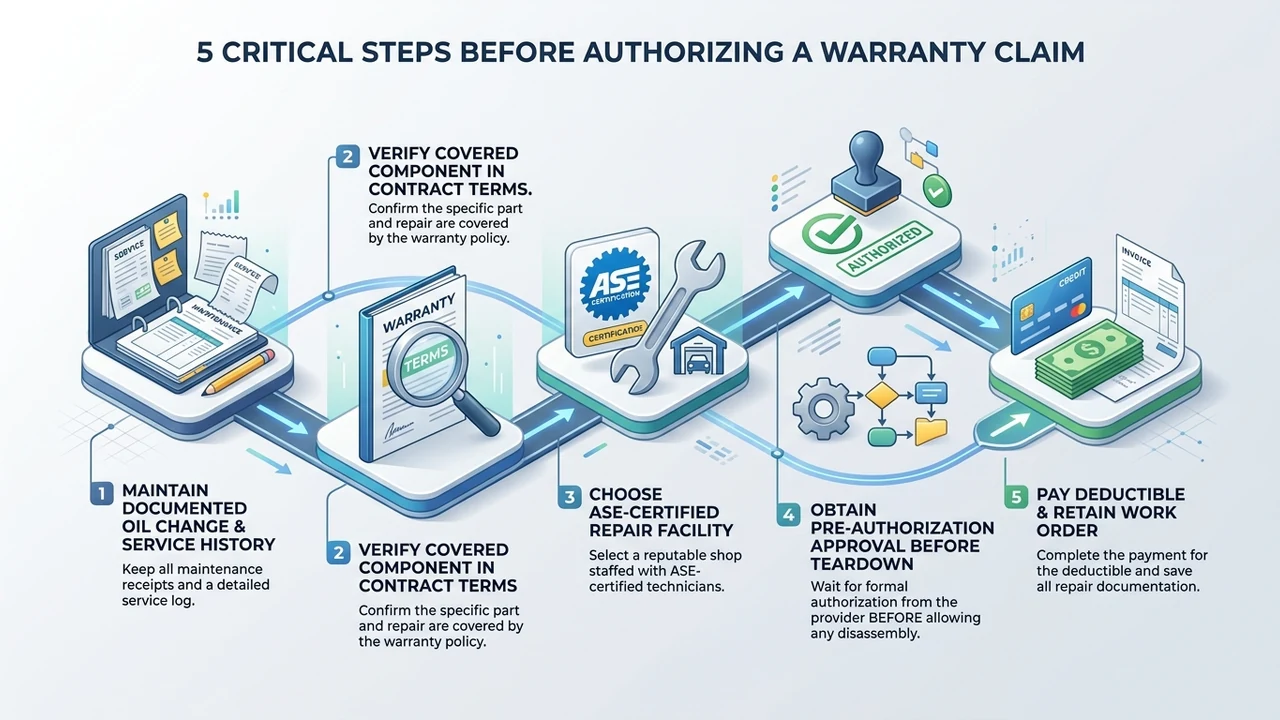
- Call your warranty company and get approval before any repair starts
- Take the car to an approved shop with a written estimate
- Keep copies of every form, email, and invoice from start to finish
Before you file, do one free check that many drivers forget. Search your car for an open safety recall, because recall repairs cost you nothing and are separate from your warranty. According to NHTSA, there were 997 vehicle safety recalls in 2025 affecting more than 29 million vehicles, and manufacturers must fix those defects for free at the dealer.
Timing is your friend during review. Reply fast when the company asks for something. A pending claim can stall for days if you go quiet, but it speeds up the moment you answer. If yours is stuck in limbo, see how we handle the 24-hour rule to speed up a pending claim and cut the wait.
Keep every scrap of paper until the claim fully closes and the money lands. Do not toss anything early. If a question pops up two months later, your file answers it. In my experience, drivers who hold their records through the whole process almost never get stuck, while those who clean out too soon sometimes lose a fight they had already won.
How Long a Warranty Claim Takes and What to Expect
I’ve handled cases where a claim closed in a single afternoon, and others that dragged on for weeks — and the difference almost always came down to prep. A ready driver with a full folder gets a fast answer. A driver missing one receipt waits while the company digs. From what I have seen, strong prep can shave the wait down by half or more.
Here is the honest picture of what happens after you file. First, the company reviews your documents and the shop’s estimate. Then they may ask for more proof or a second look at the car. Once they approve, the shop does the repair and gets paid. Simple claims can wrap in a day or two, while bigger engine jobs take longer because they need more checks.
Set your expectations early so you are not caught off guard. Ask the agent for a rough timeline when you file. Ask who to call for updates. Keep that name and number handy. Staying in touch keeps your claim near the top of the pile, and a claim that gets attention tends to close faster than one that sits and waits.
If the wait feels too long, do not just stew about it. Follow up politely, send any missing item the same day, and keep notes of each call. Being ready and being kind is a strong combo. In my work, the drivers who prepare well and stay calm get the smoothest results, and they walk away far less stressed than the rest.
Getting Ready Is the Real Win
Filing a warranty claim does not have to feel like a fight. The secret is boring but true — get ready before you need to. Keep your receipts. Track your service with dates and mileage. Know what your plan covers. Do these small things, and a scary breakdown turns into a quick, covered fix.
Your car will break down someday. That part you cannot control. But you can control your folder, your notes, and your proof. Those three things decide how the day ends. Start your file this week, even if your car runs perfectly right now, because the best time to prepare is long before the trouble starts.
If you need a hand reviewing your plan or getting your claim ready, we are here for you. We can look at your coverage, spot the gaps, and help you file with confidence. Have you checked your own records lately? Take ten minutes today, and your future self will thank you when the road gets rough.
Frequently Asked Questions
What papers do I need before I file a warranty claim?
You need your warranty or service contract, all your oil change receipts, and your full maintenance records with dates and mileage. Add past repair invoices and your vehicle registration too. Keep both paper and phone-photo copies in one folder. In my experience, a full folder is the single biggest reason claims get approved fast.
Can my claim be denied if I did my own oil changes?
No, not just for that reason. Federal rules say a dealer cannot deny your warranty only because you or another shop did routine work. The catch is proof. You must keep the receipts and notes that show the work was done on time. Without that record, the company can question your care and slow or stop the claim.
How do I prove I took care of my car?
You prove it with a clear paper trail. Save every service receipt and sort them by date, oldest to newest. Each one should show the mileage, the dates, and the services performed. A neat history reads like a story of good care. That story is what convinces a reviewer to say yes instead of no.
Do I have to use the dealer for repairs?
Usually not, but it depends on your plan. Many warranties let you pick any approved shop, not just the dealer department. Some plans do have shop rules or need approval first, so check your contract before you file. Call and ask which shops qualify. One quick question here can save you from a denied claim later.
How long does a warranty claim take to get approved?
It depends on your prep and the size of the repair. A simple, well-documented claim can clear in a day or two. A big engine job may take a week or more because it needs deeper checks. Reply fast to any request and keep copies of everything. Ready drivers almost always get the quickest answers.