
If your car loses power while driving, that sinking feeling in your chest is very real. One second you are cruising fine, and the next the engine feels like it is running on fumes. I have been there too, stuck in the middle lane on a busy road, pressing the gas and going nowhere. It is one of those problems that makes you feel helpless fast. But the good news? Most causes are fixable once you know what to look for.
Why Does a Car Lose Power While Driving?
Your car engine needs three things to run properly: the right amount of fuel, enough clean air, and a strong spark to ignite it all. When any one of these three things is missing or off balance, your engine cannot produce full power. Simple as that.
Sometimes the problem is small, like a dirty air filter blocking airflow. Other times, it is something bigger like a failing fuel pump or a bad ignition coil. Either way, understanding the cause is the first step to fixing it.
Warning Signs to Watch For
Before we get into the specific causes, let me show you what a power loss actually looks and feels like. These are the most common symptoms drivers notice:
| Symptom | What It Means |
| Sluggish acceleration | Car feels heavy when you press the gas |
| Engine misfires | Rough, shaking feeling at idle or while driving |
| Check engine light on | ECU detected a fault in the system |
| Reduced fuel efficiency | You are filling up more often than normal |
| Stalling or hesitation | Engine pauses or shuts off when accelerating |
When Should You Pull Over Immediately?
If your car suddenly loses a lot of power on a fast road or freeway, pull over safely right away. Turn on your hazard warning lights to warn other drivers. Do not keep pushing the engine if it is struggling badly. Call for help if you need to. Your safety comes first, always.
Important Safety Note: A sudden and total loss of engine power at high speeds can be dangerous. Always move to the shoulder carefully, turn on your hazard lights, and do not try to restart a very hot or smoking engine.
9 Most Common Causes When a Car Loses Power While Driving
Let us go through each one clearly. I will explain what happens, why it matters, and what you can do about it.
Fuel System Problems
1. Clogged Fuel Filter
This is one of the most common reasons a car loses power while driving. The fuel filter keeps dirt and debris out of the engine. Over time, it gets blocked and your engine does not get enough fuel.
When the fuel filter is clogged, the fuel pump has to work much harder than normal. This causes poor fuel delivery, weak acceleration, and sometimes stalling at higher speeds.
Fix: Replace the fuel filter. Most mechanics recommend doing this every 20,000 to 30,000 miles. It is not expensive and takes about an hour.
2. Failing Fuel Pump
Your fuel pump pushes fuel from the tank to the engine at the right fuel pressure. When it starts to fail, the engine does not get a steady supply of fuel. You will notice the car losing power especially when driving uphill or under heavy load.
Honestly, a failing fuel pump is one of the scarier ones because it can lead to full stalling on the road. I have seen cars limp off the highway because the pump gave out at the worst time.
Fix: A mechanic will test your fuel pressure. If the pump is weak, it needs to be replaced. This can cost between $250 and $800 depending on your car.
3. Dirty or Faulty Fuel Injectors
Fuel injectors spray the right amount of fuel into the combustion chamber. If they get clogged or start misfiring, the fuel-air mixture goes wrong. This causes the engine to run rough and lose power.
Dirty fuel injectors are very common in cars that have not had a proper service in a while. Bad quality fuel can also clog them faster.
Fix: Try a fuel injector cleaner additive first. If that does not help, have them professionally cleaned or replaced.
Air and Ignition System Problems
4. Dirty or Clogged Air Filter
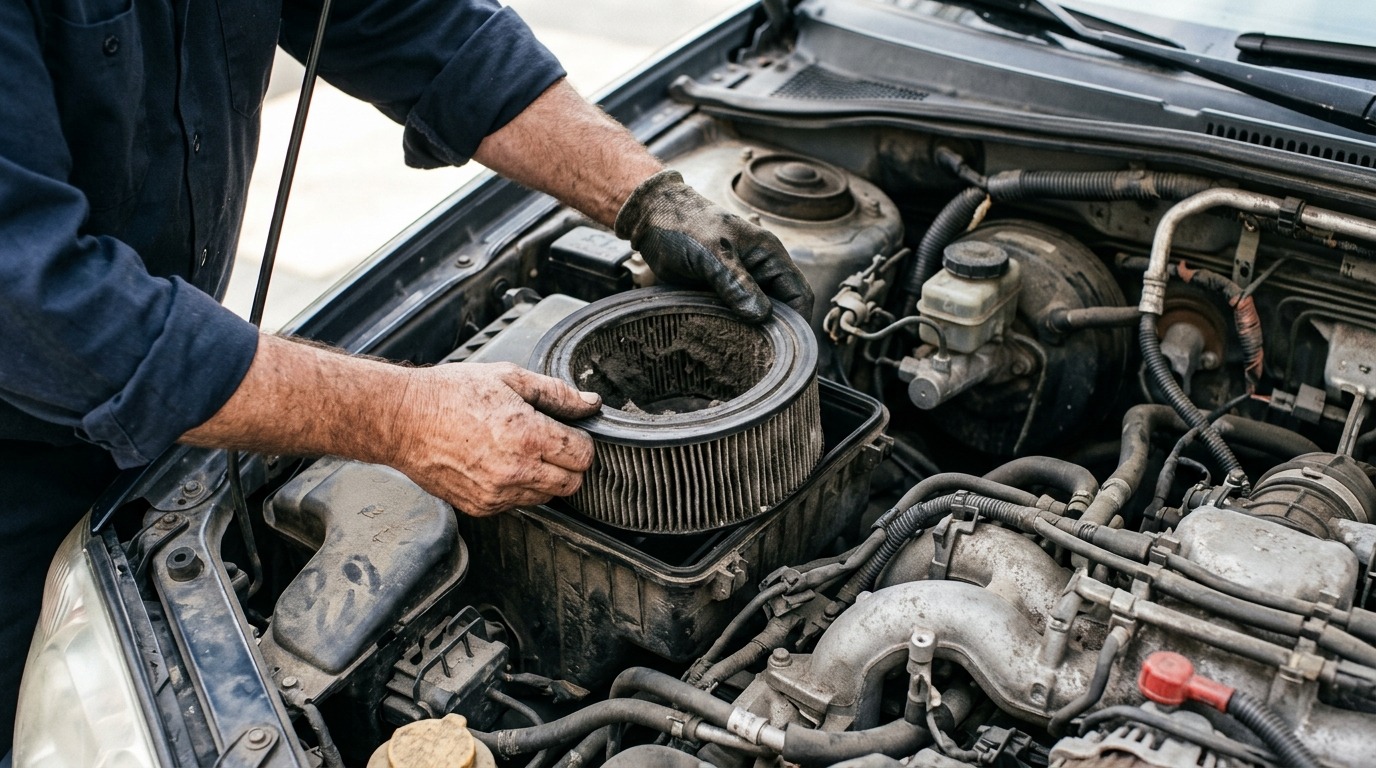
Your engine needs a good flow of clean air to burn fuel properly. A dirty air filter chokes this airflow and makes the engine work harder for less output. You will feel the car feeling sluggish, especially when you try to speed up fast.
This is actually one of the cheapest and easiest fixes on this whole list. A new air filter costs as little as $15 and takes about 10 minutes to swap out. I always check mine first whenever I feel any slowdown, because it has saved me a lot of money on unnecessary diagnostics.
Fix: Check your air filter every 12,000 miles. Replace it if it looks grey or clogged with dust.
5. Worn Out Spark Plugs or Bad Ignition Coils
Spark plugs create the spark that ignites the fuel-air mixture inside the engine. When they wear out, the engine starts to misfire. You get that rough, shaking feeling and a clear loss of power.
A bad ignition coil makes things even worse. The coil converts battery power into the high-voltage spark the plugs need. If the coil is weak, the spark is weak, and the engine does not fire cleanly.
Fix: Replace spark plugs every 30,000 to 50,000 miles (or up to 100,000 miles for platinum or iridium plugs). Have your ignition coils checked at the same time.
According to the U.S. Department of Energy’s Office of Energy Efficiency, fixing faulty spark plugs and ignition issues can improve your vehicle’s fuel economy by up to 30%. Source: energy.gov
6. Faulty Mass Airflow Sensor (MAF) or Oxygen Sensor
The mass airflow sensor tells the engine how much air is coming in so it can mix the right amount of fuel. If this sensor gives wrong readings, the engine gets too much or too little fuel. The result is poor performance and more fuel being burned for less power.
A bad oxygen sensor causes a similar problem. It monitors the exhaust gases to help the engine stay in the right balance. When it fails, your fuel efficiency drops and power goes with it.
Fix: An OBD-II scanner will usually show a fault code for these sensors. Replacing them is typically a simple job a mechanic can do in under an hour.
Exhaust, Transmission and Electrical Causes
7. Blocked Exhaust System or Clogged Catalytic Converter
Your exhaust system lets waste gases escape from the engine. If the catalytic converter gets blocked, the engine cannot breathe out properly. This creates back pressure that kills power fast.
You might notice a rotten egg smell from the exhaust if the catalytic converter is failing. The car may also suddenly go into what is called limp mode, where it restricts speed to protect the engine from more damage.
For diesel cars, a blocked diesel particulate filter (DPF) can do the same thing. A clogged DPF often triggers limp mode and limits you to slow speeds until it is cleared.
Fix: Have the exhaust system and catalytic converter inspected. A clogged converter usually needs to be replaced, which can be pricey but is necessary.
8. Transmission Problems or Slipping Gears
If your car feels like it is losing power when shifting or maintaining speed, the transmission could be the issue. A slipping transmission means power from the engine is not being properly sent to the wheels.
Signs of this include the engine revving high (high RPMs) while the car barely moves faster. You might also notice delayed acceleration or strange noises when shifting.
Fix: Check your transmission fluid first. Low or burnt fluid is a common cause. If the fluid is fine, have a mechanic check for worn clutch plates or internal damage.
9. ECU Error or Weak Alternator
The Engine Control Unit (ECU) is basically your car’s computer brain. If it gives a false reading or has a fault, it can put your car into limp mode as a protection step. This dramatically cuts power to prevent engine damage.
A weak alternator can also cause power loss, especially when you are using a lot of electrical things at once, like headlights, air conditioning, and music. The alternator charges the battery and powers the electronics. If it is struggling, the whole system feels it.
Fix: For ECU issues, restart the engine and see if the problem clears. If not, get a diagnostic scan. For a weak alternator, have it load-tested at any auto parts store, often for free.
The National Highway Traffic Safety Administration (NHTSA) actively investigates vehicle power loss complaints and issues recalls for serious cases. In 2025, Ford recalled over 312,000 vehicles due to a power assist malfunction while driving. You can check your vehicle for open recalls at: nhtsa.gov/recalls
How to Diagnose Why Your Car Loses Power
Simple Steps You Can Do at Home
You do not need to be a mechanic to do basic checks. Here is a simple way to start figuring out what is wrong:
Step 1: Note when it happens. Does the car lose power under heavy acceleration? Only on hills? At high speeds? Or even just sitting at idle? This helps narrow things down a lot.
Step 2: Check your dashboard. A glowing check engine light is a direct message from your car. Do not ignore it. You can buy an inexpensive OBD-II scanner online for under $30 and read the fault codes yourself.
Step 3: Check the easy stuff first. Look at the air filter, check your fuel level, and inspect the spark plugs if you can. These simple checks can save you a $100 diagnostic fee at a shop.
Pro Tip: If your car goes into limp mode (very limited speed and power), do not ignore it. Drive slowly to the nearest safe place and get it diagnosed. Limp mode is your car protecting itself from serious damage.
When to Take It to a Mechanic
To be fair, some problems really do need a professional. If you have done the basic checks and still cannot find the cause, or if the car is stalling completely or making unusual noises, book it in with a trusted garage.
A mechanic will use a proper diagnostic scanner, check fuel pressure, test the mass airflow sensor and ignition system, and inspect the exhaust. Most shops can give you a diagnosis in an hour or two.
Conclusion
A car that loses power while driving is not something to push through and hope gets better. In most cases, catching the problem early saves you real money and keeps you safe on the road.
Start with the simple stuff: check the air filter, inspect the spark plugs, and scan for fault codes. From there, work through the fuel system, the ignition system, and the exhaust. Nine times out of ten, the answer is in one of those areas.
If you have ever dealt with this problem before, I would love to hear what fixed it for you. Drop your experience in the comments below, it might help someone else.
Frequently Asked Questions (FAQs)
Q1. Why does my car lose power while driving uphill?
Driving uphill puts extra load on the engine, which needs more fuel and air to keep up. If your fuel pump is weak, your air filter is dirty, or your fuel injectors are clogged, this extra demand exposes the problem fast. You will feel the car slow down and struggle even when you press the gas all the way down.
Q2. Can a bad catalytic converter cause my car to lose power?
Yes, absolutely. A blocked catalytic converter creates back pressure in the exhaust system and stops the engine from breathing out properly. This directly reduces engine output. You may also notice a sulphur or rotten egg smell from the exhaust when the converter is failing.
Q3. What does it mean if my car goes into limp mode?
Limp mode (also called limp-home mode) is when the car’s ECU detects a serious problem and limits the engine’s power to prevent more damage. Your speed will be cut, sometimes to as low as 30 mph. Common causes include a blocked DPF filter, a faulty sensor, or a serious engine misfire. Get it diagnosed as soon as possible.
Q4. How do I know if my fuel pump is failing?
A failing fuel pump usually shows these signs: the car loses power under heavy acceleration, the engine sputters at high speeds, you hear a whining noise from the fuel tank area, and the car stalls and is hard to restart. The best way to confirm it is a fuel pressure test done by a mechanic or with a fuel pressure gauge.
Q5. Is it safe to keep driving if my car is losing power?
It depends on how much power you are losing. If the car is barely moving, stalling, or showing warning lights, stop driving it. Continuing to drive can make the problem much worse and more expensive to fix. Pull over safely, turn on your hazard lights, and call for help if needed. It is always better to be safe than to turn a small repair into a big one.