
If you drive around Huntsville and your mechanic says, “Your timing belt is due,” you might freeze up. What even is that? Is it serious? And how is it different from a timing chain?
Don’t worry. I’ll break it all down for you simply and clearly.
What Does a Timing Belt or Timing Chain Actually Do?
Your car’s engine has two big parts that must work together at all times. One is called the crankshaft (it moves the pistons up and down). The other is called the camshaft (it opens and closes the engine valves). If these two parts fall out of step, even for a second, your engine can get badly damaged.
That’s where the timing belt or timing chain comes in. It connects these two parts and keeps them moving in perfect sync. Think of it like a metronome for your engine: it keeps everything in time.
Interference vs. Non-Interference Engines: Why It Matters for Huntsville Drivers
Here’s something a lot of drivers don’t know. Some engines are called interference engines. In these engines, the pistons and valves share the same space inside the cylinder just at different times. If the timing goes wrong, the piston can slam into a valve and cause major engine damage.
Other engines are called non-interference engines. These are safer if the timing slips, but they will still run badly.
Many popular cars driven in Huntsville, like older Toyotas, Hondas, and Volkswagens, use interference engines. So, timing system failure is not just an inconvenience. It can mean a wrecked engine.
What Is a Timing Belt?
How a Timing Belt Is Made and How Long It Lasts
A timing belt is made of tough rubber. It is often reinforced with fibers like fiberglass or Kevlar to make it stronger. It wraps around the crankshaft and camshaft pulleys and uses tension from small pulleys to stay tight.
Rubber is flexible and quiet, which is a good thing. But it does wear out over time, especially in the heat. And Huntsville summers can push engine temperatures pretty high.
Most car makers recommend replacing a timing belt every 60,000 to 100,000 miles. Some vehicles also have a time-based interval, not just a mileage one. So even if you don’t drive much, the rubber can still age and crack.
I once had a friend in Madison (just outside Huntsville) who ignored his timing belt replacement because “it seemed fine.” At 98,000 miles, it snapped on I-565. The tow truck bill, the engine repair cost him over $4,000. He said he wished he had just paid the $600 for the belt replacement when his mechanic first told him.
Warning Signs Your Timing Belt Is Going Bad
Watch for these signals:
- A ticking or slapping noise from the engine area
- Engine misfires or rough idling
- Hard time starting the car
- Oil is leaking near the timing cover
- A check engine light that keeps coming on
If you see any of these signs, take your vehicle to an auto repair shop in Huntsville as soon as possible. A broken timing belt can destroy your engine in seconds.
What Is a Timing Chain?
How a Timing Chain Works and Why It Lasts Longer
A timing chain does the same job as a timing belt, but it is made of metal links just like a bicycle chain. It sits inside the engine and is held in place by tensioners that use engine oil pressure to keep it tight.
Because it is made of metal, a timing chain is far stronger than a rubber belt. Many car makers say a timing chain is built to last the life of the engine. Under good conditions, that can be 150,000 to 200,000 miles or even more.
Most newer cars and trucks sold today, including many popular SUVs like the Ford Explorer, Chevy Silverado, and RAM trucks, come with timing chains. If you bought your car new in the last 10 years, chances are good you have a chain, not a belt.
Timing Chain Warning Signs Huntsville Drivers Should Not Ignore
Timing chains do not snap suddenly like belts. Instead, they stretch slowly over time. A stretched chain can skip a tooth on the sprocket, which throws off the engine timing.
Look for these warning signs:
- A rattling noise when you first start the car (especially in cold Huntsville mornings)
- A check engine light linked to timing codes
- Sluggish acceleration or poor fuel economy
- Oil pressure issues (low oil can cause the chain to go loose)
The good news? These symptoms usually give you some warning before things get serious. But you should still get it checked right away.
Timing Belt vs Timing Chain: Side-by-Side Comparison
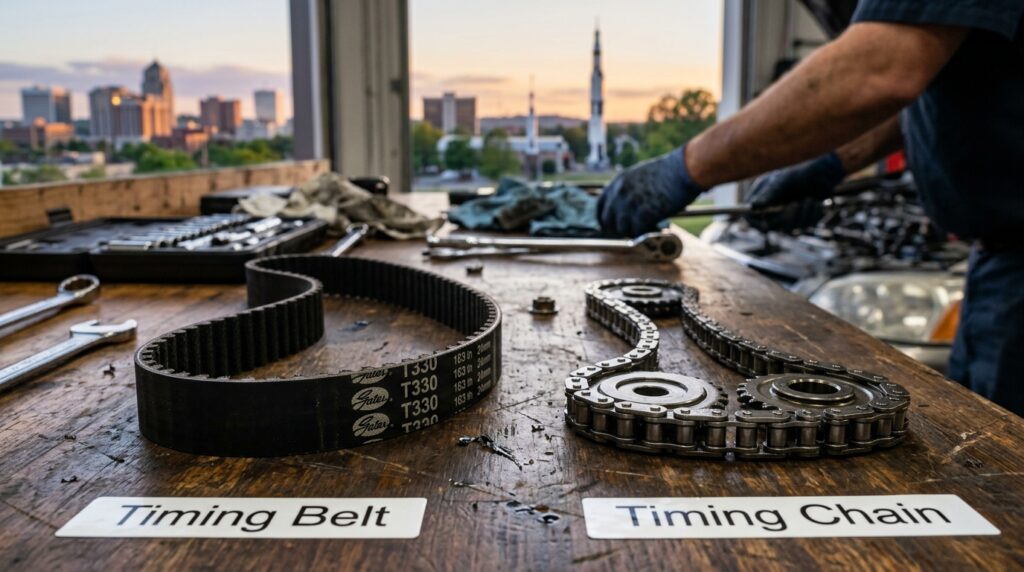
Cost, Lifespan, and Maintenance Differences
Here is a simple breakdown that Huntsville drivers can use:
| Feature | Timing Belt | Timing Chain |
| Material | Rubber | Metal |
| Lifespan | 60,000 – 100,000 miles | 150,000+ miles (often lifetime) |
| Replacement Cost | $500 – $1,000 | $1,000 – $2,500+ |
| Noise Level | Very quiet | Slightly noisier |
| Lubrication | Not needed (dry setup) | Needs engine oil |
| Failure Style | Snaps suddenly | Stretches gradually |
According to data shared by Universal Technical Institute, timing belt replacement usually runs between $500 and $1,000. That often includes replacing the water pump, idler pulleys, and tensioners at the same time because they are all easy to reach during the job.
Timing chain repairs cost more often $1,000 to $2,500 or higher because getting to the chain deep inside the engine takes a lot of labor time.
Which Is Better for Huntsville Driving Conditions?
Honestly? Both can work great if you take care of them.
Huntsville’s weather mixes hot summers and cold winters. That kind of temperature swing can be hard on rubber, which means timing belts in older vehicles need attention on schedule. If you drive a lot of highway miles on I-565 or commute up to Redstone Arsenal every day, your belt reaches its mileage limit faster.
If you have a newer vehicle with a timing chain, your main job is simple: keep up with regular oil changes. The chain lives in engine oil. Dirty or low oil is the biggest enemy of a timing chain.
According to a maintenance guide published by Cars.com, changing your oil at the recommended intervals can significantly extend the life of a timing chain, sometimes to the full life of the engine.
How to Find Out If Your Car Has a Belt or a Chain
Quick Ways to Check Your Vehicle
You don’t need to be a mechanic to figure this out. Here are three easy ways:
- Check your owner’s manual. Look under the maintenance schedule section. If it lists a timing belt replacement interval, you have a belt. If there is no mention of it, you likely have a chain.
- Look at the engine cover. Timing belts are usually covered by a plastic cover on the outside of the engine. Timing chains are inside the engine block and covered by a metal cover. Plastic outside cover usually means belt. Metal cover usually means chain.
- Search online. Just type your car’s year, make, model, and engine size plus “timing belt or chain.” You will find the answer in seconds.
If you are still not sure, any honest auto repair shop in Huntsville can tell you in a few minutes.
Does It Matter Which Type You Have?
Yes, it does because your maintenance plan changes depending on which one you have.
If you have a belt, you need to track your mileage and follow the replacement schedule strictly. Missing it can cost you thousands.
If you have a chain, you need to focus on regular oil changes and watch for the warning signs we talked about earlier.
Either way, you are not powerless. You just need to know what you are working with.
What to Expect When You Take Your Car to a Huntsville Mechanic
What a Timing Belt Replacement Involves
When you bring your car in for a timing belt service, a good mechanic will usually do more than just swap the belt. They will often recommend replacing the water pump, tensioners, and idler pulleys at the same time. These parts are right there and accessible, and replacing them now saves you a bigger labor bill later.
The full job can take a few hours. Honest shops in Huntsville like the Christian Brothers Automotive locations on South Memorial Parkway and Hampton Cove will walk you through what is needed and show you the old parts.
What a Timing Chain Service Involves
Timing chain work is more involved. The mechanic has to get deep into the engine. They will check the chain itself, the tensioners, and the guides (small plastic pieces that keep the chain on track). All worn parts usually get replaced together.
This is a bigger job, but if your engine has been well-maintained and the chain has not stretched too much, the repair should get you many more miles of smooth driving.
Conclusion
The timing belt vs timing chain debate comes down to one simple idea: both systems do the same job, but they need different care.
If your vehicle has a timing belt, respect the replacement schedule usually every 60,000 to 100,000 miles. In Huntsville’s heat, rubber wears faster than you think.
If your vehicle has a timing chain, keep up with your oil changes and listen for any unusual rattling. A well-oiled chain can last the life of your engine.
Either way, do not wait until something breaks. A small maintenance cost now is always better than a huge repair bill later. If you are not sure what your car has or when it was last serviced, talk to a trusted mechanic in Huntsville soon.
Have you dealt with a timing belt or chain issue before? I’d love to hear how it went in the comments below.
Frequently Asked Questions
What is the main difference between a timing belt and a timing chain?
A timing belt is made of rubber and must be replaced every 60,000 to 100,000 miles. A timing chain is made of metal and is built to last much longer, often the entire life of the engine. Both connect the crankshaft and camshaft and keep your engine running in sync. The key difference is material, lifespan, and maintenance needs.
How do I know if my car in Huntsville has a timing belt or timing chain?
The easiest way is to check your owner’s manual. Look for a timing belt replacement interval in the maintenance schedule. If it is listed, you have a belt. You can also look at your engine. A plastic cover on the outside usually means a belt. A metal engine cover usually means a chain. Or just ask a local Huntsville mechanic they can tell you in minutes.
What happens if a timing belt breaks while I’m driving?
If your timing belt breaks while driving, your engine will shut off immediately. In an interference engine, the pistons can slam into the open valves and cause very serious damage sometimes requiring a full engine replacement. This is why following the replacement schedule is so important. Do not skip it.
How much does timing belt or timing chain replacement cost in Huntsville?
Timing belt replacement typically costs between $500 and $1,000 in the Huntsville area. This usually includes the water pump, tensioners, and pulleys. Timing chain replacement is more expensive, often between $1,000 and $2,500 or more because it requires more labor to access the chain inside the engine.
Can I drive with a bad timing belt or stretched timing chain?
It is not safe to drive with a known bad timing belt or a stretched timing chain. Both can cause serious engine damage if they fail while the car is running. If you hear rattling noises, notice poor performance, or your check engine light comes on with timing-related codes, get your car to a Huntsville mechanic right away. Catching it early is always cheaper than waiting for a full failure.