
Have you ever turned your key and heard nothing but silence? That heart-drop moment is your first real lesson in how your car’s electrical system works. It’s not magic. It’s a simple loop of power moving from one part to another, and once you get it, your car stops feeling like a mystery box.
I still remember the first time my old car wouldn’t start on a freezing morning. I had no idea if it was the battery, the starter, or something else. That morning taught me more about cars than any manual ever did. In this guide, I’ll walk you through the same lessons in plain, simple words, no confusing terms, just real answers.
What Is a Car’s Electrical System?
The Basic Job It Does
Your car’s electrical system is a small power network. Its main job is simple: it moves electricity from the battery to every part that needs power lights, radio, fuel pump, and more.
Why It’s Called a “Closed Circuit”
We call it a closed circuit because power always comes back to where it started. Current flows out of the battery, through a wire, into a part like a light bulb, and then back to the battery through the car’s metal body. Nothing leaks out. It’s a full loop, not a one-way trip.
The Main Parts of the Electrical System
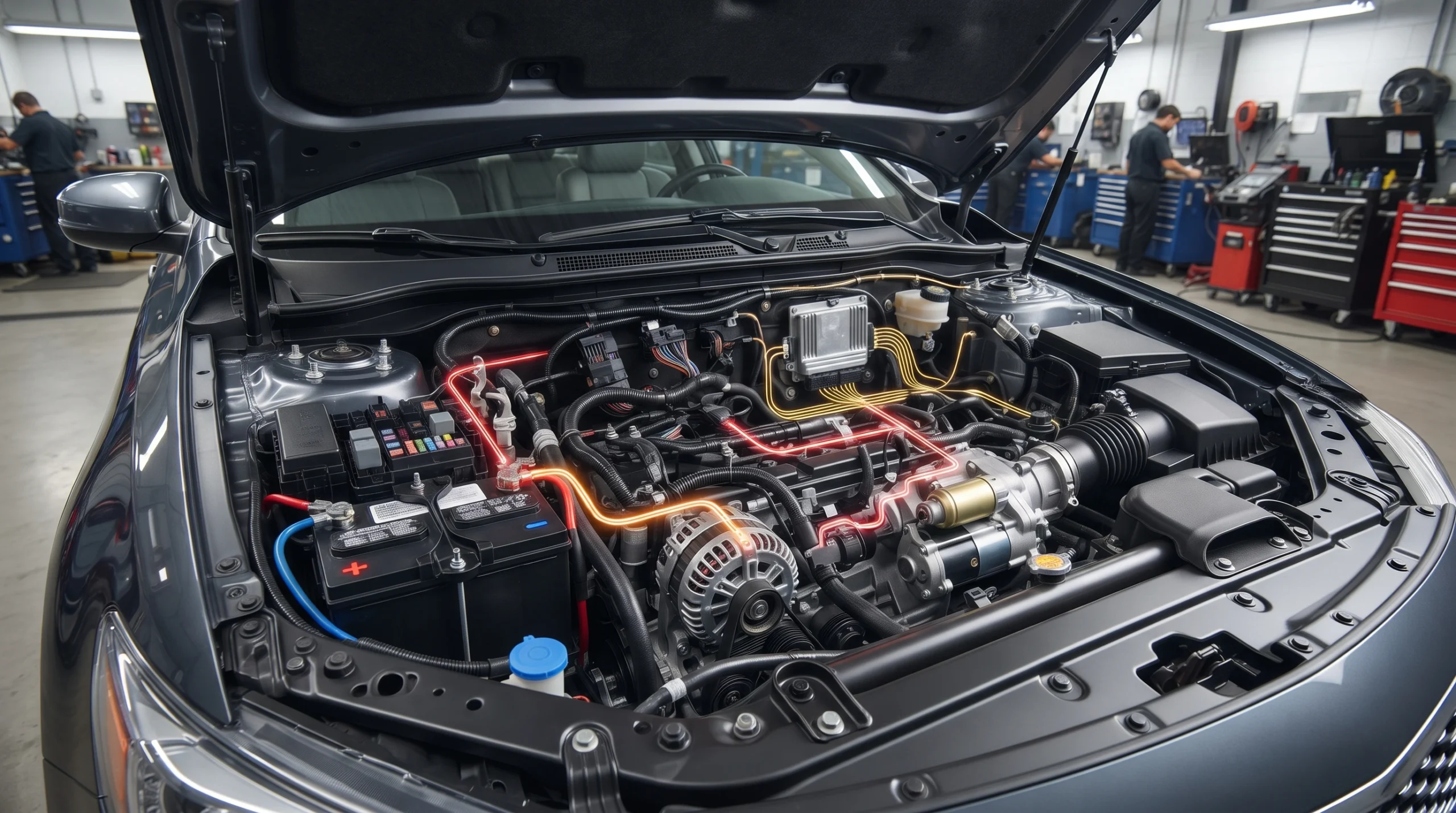
Battery, Alternator, and Starter Motor
These three parts are the heart of the whole system, and honestly, once you know them, half your car troubles start making sense.
The battery stores power in chemical form. When you turn the key, it sends a burst of energy to the starter motor, which turns the engine over so it can start running on its own.
Once the engine is on, the alternator takes over. It turns spinning engine power into electricity using basic electromagnetism, and it does two jobs at once: it powers everything running (lights, AC, radio) and it recharges the battery at the same time. Think of the battery as a phone battery and the alternator as the charger plugged in the moment your engine starts.
Fuses, Relays, and Wiring
Here’s the part most people never think about until something breaks. Fuses are tiny safety guards. If too much current tries to flow through a wire, the fuse “sacrifices” itself and breaks the circuit before something worse happens, like a fire.
Relays are like small remote-control switches. Instead of running high power through your fingertip-sized dashboard switch, a relay lets a small signal control a much bigger current safely; that’s how your headlights or power windows turn on without frying the switch.
Then there’s the wiring harness, the bundle of wires running through the whole car. Some wires are thick (like the ones from the battery to the starter), and some are thin (like the ones running to a small sensor). Thicker wires carry more current safely.
How Electricity Actually Flows Through Your Car
From the Battery to the Component and Back
Picture this: power leaves the battery’s positive side, travels through a wire, reaches a part like your headlight, lights it up, and then returns through the car’s metal body back to the battery. That’s the full loop, every single time you flip a switch.
This is why a loose or rusty connection to the car’s body can cause weird electrical problems. The path back to the battery matters just as much as the path out.
What “Earth-Return” and “Negative Earth” Mean
This confused me for years, honestly. In most cars, the negative side of the battery connects to the car’s metal frame. We call this the earth or ground. So instead of running a separate wire back to the battery for every single part, the car’s whole metal body acts like one giant return wire. That’s why it’s called an earth-return system, and since the negative side is grounded, we call it a negative earth system.
Basic Electrical Terms Every Driver Should Know
Volts, Amps, and Watts Explained Simply
Let’s make this easy with a water analogy, because it just clicks better this way.
Voltage (measured in volts) is like water pressure it’s the push behind the electricity. Amperage (measured in amps) is like how much water is actually flowing. Watts is the total power used, and you get it by multiplying volts by amps.
Most cars run on a 12-volt system. A basic light bulb pulling 4 amps at 12 volts uses 48 watts. There’s no need to overthink math.
What Resistance (Ohms) Means for Your Car
Resistance, measured in ohms, is how much a wire pushes back against the flow of current. Thin wires resist more than thick ones. This matters because too much resistance turns electrical energy into heat, and that’s exactly how a fuse blows or a bulb filament glows.
What Role Does the Battery Play?
How the Battery Stores and Releases Power
Your car’s battery is basically a chemical energy tank. Inside, it holds several small cells connected together, each producing just over 2 volts, adding up to the 12-volt total your car needs.
When the engine is off, the battery powers everything: your dome light, your alarm system, your radio memory. The moment you turn the key, it releases a strong burst of current to crank the starter motor. Once the engine runs, the alternator takes the load off the battery and tops it back up.
Signs Your Battery Is Struggling
I once ignored a slow-cranking sound for almost two weeks, thinking it was “just cold weather.” It wasn’t. It was a dying battery, and it finally gave up on a Monday morning in a parking lot.
Cold weather really does hit batteries hard, and this isn’t just a guess it’s backed by real testing. According to AAA – The Auto Club Group, cold weather sharply reduces a battery’s ability to hold a charge, and slow cranking is one of the clearest early warning signs that a battery is failing. AAA also recommends having your battery tested once it’s more than three years old, which is honestly a good habit even if nothing feels wrong yet.
Watch for dim headlights, a clicking sound when you turn the key, or accessories acting slow and glitchy. Any of these mean it’s time for a check, not a guessing game.
If you ever notice these warning signs and you’re not sure what’s going on, feel free to reach out. We can run a full electrical check and tell you exactly what’s happening under the hood.
How Does the Alternator Keep Everything Running?
Turning Engine Power Into Electricity
The alternator is honestly one of the most underrated parts of your car. It’s bolted to the engine and spins using a belt. As it spins, it uses electromagnetism to generate an alternating current, which gets converted into the direct current your car actually uses.
Without the alternator, your battery would drain within minutes of starting the engine, because everything lights, fuel pump, ignition pulls from the electrical system nonstop while you drive.
What Happens If the Alternator Fails
Here’s something people get wrong all the time: a failing alternator often feels exactly like a dying battery at first. Dimming headlights, a weak radio, warning lights flickering on the dash but if you replace the battery and the same problems come back within days, the alternator is usually the real problem.
A car can sometimes still run for a short while on a failing alternator, using only whatever charge is left in the battery. But once that charge is gone, the engine simply shuts off, and it won’t restart until the charging system is fixed.
What Is Polarity, and Why Does It Matter?
Positive vs. Negative Terminals
Every battery has two terminals: positive and negative. Power always tries to flow from positive to negative, and this one-way behavior is called polarity.
Why Wiring the Wrong Polarity Can Damage Parts
Some electrical parts, like radios or sensors, only work correctly if the current flows through them in the right direction. Connect something backward, and at best it just won’t work at worst, you can damage the part completely. That’s why any new accessory you install should always match your car’s polarity, which for almost all modern cars is negative earth.
Why Do My Lights Dim When I Start the Car?
The Starter’s High Power Demand
This one has a simple answer: the starter motor pulls a huge burst of current the moment you turn the key, way more than your headlights need. That sudden pull temporarily lowers the voltage available to everything else, so your lights dip for a second.
Is This Normal or a Warning Sign?
A quick, small dim that bounces right back is completely normal; it happens in almost every car. But if the dim is heavy, lasts a while, or happens every single time along with slow cranking, that’s your battery or alternator asking for attention, not just “one of those things.”
Why Is My Car Harder to Start in Winter?
How Cold Affects Battery Power
Cold weather slows down the chemical reaction happening inside your battery, which means it simply can’t push out power as fast as it can on a warm day. At the exact same time, cold engine oil is thicker, so the starter motor has to work harder to turn the engine over. It’s a double hit, and that’s why winter mornings are brutal on weak batteries.
Simple Tips to Help It Start Easier
Turn off anything electrical lights, seat heaters, the radio before you crank the engine, so the starter gets all the power it can. Keep your battery terminals clean, since corrosion adds resistance right when you need current the most. And honestly, if your battery is already a few years old, don’t wait for winter to test it. Get it checked before the cold hits, not after you’re stuck in a parking lot at 6 a.m.
What Do Car Fuses Actually Do?
How a Fuse Protects the Circuit
A fuse is a tiny, deliberately weak link in the circuit. If current flowing through a wire ever spikes too high, the thin metal strip inside the fuse melts and breaks the connection instantly, before the wire overheats or catches fire.
Common Signs of a Blown Fuse
A single feature suddenly stops working, and nothing else around it changes; that’s the classic sign. Your radio dies but the headlights still work fine, or your power windows stop but the AC runs normal. Check your fuse box (usually under the dash or near the engine bay); a blown fuse usually has a visibly broken metal strip inside it, and swapping it for one with the same amp rating almost always fixes the problem in minutes.
Common Car Electrical Problems and What They Mean
Battery, Starter, and Alternator Warning Signs
Let’s connect the dots we’ve covered so far, because in real life, these three parts constantly get mixed up.
A weak battery shows up as slow cranking, dim lights at startup, or a car that won’t start after sitting a few days. A failing starter usually makes a clicking sound but the lights stay strong, meaning power is there but the motor isn’t spinning the engine. A dying alternator looks like a battery problem that keeps coming back even after a fresh battery is installed.
When It’s a Wiring or Connector Problem
Sometimes it’s not any of the big three; it’s a corroded connector or a chewed-through wire (yes, rodents really do this). Signs include flickering lights that get worse over bumps, a part that works only sometimes, or a burning smell without any obvious source. These issues are trickier to diagnose because they can hide anywhere along the wiring harness, so this is genuinely one area where a proper diagnostic tool beats guesswork every time.
If you’re dealing with anything that sounds electrical and you can’t pin it down yourself, that’s exactly the kind of job we handle at Richmond Air. Bring it in and we’ll trace it properly instead of you swapping parts and hoping.
12-Volt vs. 48-Volt Systems: What’s Changing in Modern Cars?
Why Newer Cars Need More Power
Modern cars pack in way more electronics than cars from even ten years ago heated seats, power everything, driver-assist cameras, bigger infotainment screens. A basic 12-volt system starts running out of headroom trying to power all of that smoothly.
That’s part of why automakers have been adding 48-volt mild hybrid systems alongside the standard 12-volt setup. According to the U.S. Department of Energy’s Alternative Fuels Data Center, mild hybrid systems pair a battery and electric motor with the engine to help improve efficiency, including allowing the engine to shut off briefly at stops such as traffic lights (U.S.
What This Means for Drivers Today
For now, most everyday driving, lighting, and accessories still run on the familiar 12-volt system, with the 48-volt side quietly supporting things like engine start-stop and smoother acceleration in the background. You likely won’t notice anything different day to day, but it’s worth knowing this shift is happening, especially if you’re shopping for a newer hybrid-leaning vehicle.
How to Keep Your Car’s Electrical System Healthy
Simple Habits That Prevent Electrical Problems
Honestly, most electrical failures I’ve seen could’ve been caught early. A few small habits go a long way: keep battery terminals clean and tight, don’t leave lights or accessories running when the engine’s off, and don’t ignore a slow crank even once it’s never “just today.”
If you drive short distances often, your alternator may not get enough time to fully recharge the battery, so every couple of weeks, a longer drive helps keep things topped up.
When to Get a Professional Electrical Check
If you notice dimming lights, slow starts, warning lights on the dash, or anything acting electrically “off,” don’t wait for it to get worse. If you need a full electrical system check or a battery test, contact Richmond Air we can look at your battery, alternator, and wiring, and tell you exactly what’s going on instead of leaving you guessing.
Conclusion
Your car’s electrical system isn’t as complicated as it looks once you break it down: a battery that stores power, an alternator that keeps it topped up, a starter that gets the engine going, and wires, fuses, and relays that move everything safely where it needs to go. Next time your lights dim at startup or your car struggles on a cold morning, you’ll know exactly what’s happening instead of just hoping it goes away.
I’d love to hear if any of this matched something you’ve noticed in your own car feel free to share your experience or ask a question if something’s still unclear.
Frequently Asked Questions
What is the most common cause of car electrical problems?
A weak or aging battery is by far the most common cause, especially in cold weather or after a car sits unused for a while.
How do I know if it’s my battery or my alternator?
If a jump-start gets you going but the problem returns within a day or two, the alternator is likely not recharging the battery properly.
Can I drive with a bad alternator?
For a short distance, yes, running only on battery power but the engine will eventually stall once the battery drains completely, so it’s not safe to rely on for long.
How long does a car battery usually last?
Most car batteries last around three to five years, though hot and cold extremes can shorten that lifespan.
Is it safe to fix car electrical issues myself?
Simple things like a blown fuse or corroded terminal are safe DIY fixes. Anything involving wiring, the alternator, or the starter motor is best left to a professional, since mistakes here can cause bigger damage.