
Your car’s engine gets very hot when it runs. Without something to cool it down, it can melt and break. That “something” is engine coolant, and understanding what engine coolant is important could save you thousands of dollars in repairs.
I used to think coolant was just “that green liquid” in the car. Honestly, I did not think much about it. Then one summer, a friend’s car broke down on the highway because he ran out of coolant. The engine overheated, the parts warped, and the repair bill was over $3,000. That day, I started taking engine coolant very seriously.
In this guide, I will walk you through everything in simple words. What is coolant? What does it do? Why do you need it? And how do you keep it healthy? Let’s go.
2,000°F
Average combustion temperature inside your engine
50,000
Miles before coolant typically needs changing
60%
Of engine downtime linked to cooling problems
What Is Engine Coolant and Why Does It Matter?
Engine coolant, also called antifreeze or radiator coolant, is a special liquid that keeps your engine at the right temperature. It stops the engine from getting too hot in summer and from freezing in winter. It is one of the most important fluids in your car, right next to engine oil.
Most coolants are made of ethylene glycol or propylene glycol mixed with deionized water. This mixture also has corrosion inhibitors added to it. These ingredients work together to protect your engine from heat, cold, and rust.
What Is Engine Coolant Made Of?
A typical coolant mixture is 50% water and 50% glycol. The glycol part lowers the freezing point of the liquid so it does not freeze in cold weather. It also raises the boiling point so it does not turn into steam when the engine gets hot.
Pure water is actually very good at carrying heat. But water alone has two big problems. First, it freezes at 0°C (32°F). If it freezes inside your engine, it can crack the engine block or the cylinder heads. Second, water causes rust on iron parts. Rust then travels through the cooling system and blocks things up. This is why we mix water with glycol and corrosion inhibitor additives to create a proper coolant.
Quick Fact: According to a study by Machinery Lubrication, in a heavy-duty diesel engine, one-third of all the heat produced is removed by the engine coolant. That is how much work this fluid does every single time you drive.
Source: Machinery Lubrication – Engine Coolant Basics
The Three Main Types of Engine Coolant
Not all coolants are the same. Using the wrong one can damage your engine. There are three common types you need to know about.
| Type | Full Name | Best For | Color |
| IAT | Inorganic Acid Technology | Older vehicles | Green or Yellow |
| OAT | Organic Acid Technology | Newer vehicles | Orange, Pink, Blue |
| HOAT | Hybrid Organic Acid Technology | Most modern cars | Yellow, Turquoise |
Always check your owner’s manual before buying coolant. Using the wrong type can cause engine failure or poor performance. I made this mistake once with a used car I bought. I just grabbed a cheap green coolant from the store without checking. The mechanic later told me that car needed OAT coolant. Do not skip this step.
Why Is Engine Coolant So Important for Your Engine?
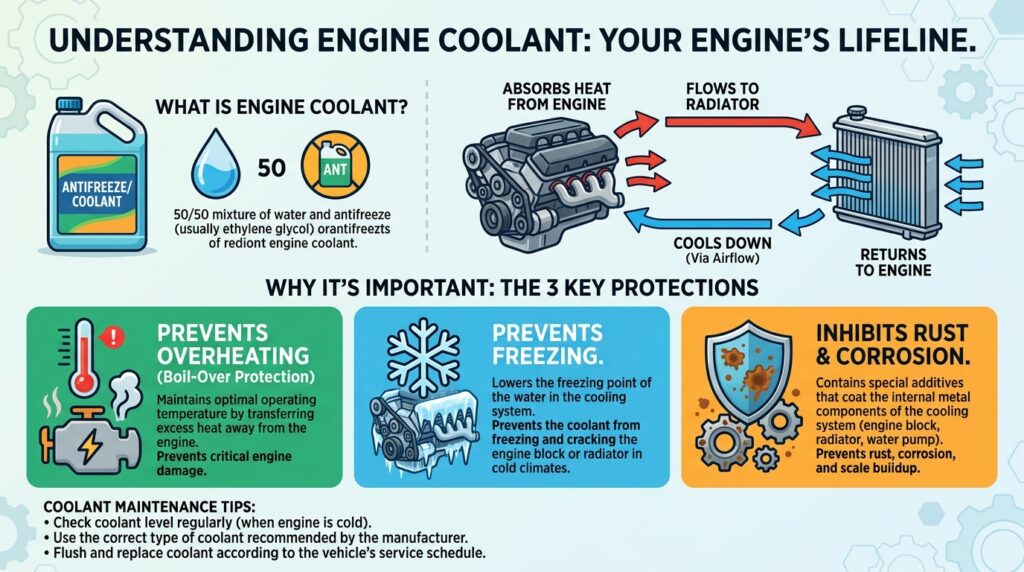
The importance of engine coolant comes down to three big jobs it does every single day. It keeps your engine cool. It stops it from freezing. And it protects the metal parts from rust and damage. Without it, your engine simply cannot survive for long.
It Prevents Your Engine from Overheating
This is the number one job. When your car runs, the internal combustion engine burns fuel to create energy. But not all of that energy moves the car. A big part of it turns into heat. Average combustion temperatures inside an engine are close to 2,000°F and can sometimes reach 4,500°F. Aluminum parts, which are in most modern engines, melt at around 1,225°F. So without cooling, the engine would destroy itself very quickly.
The coolant flows through the engine block and picks up all that heat. It then travels to the radiator at the front of the car. The radiator releases the heat into the air outside. The coolant then goes back into the engine to absorb more heat. This cycle runs the whole time you are driving.
When the car is stopped but the engine is still on, a cooling fan pulls air through the radiator to keep the coolant cool. The thermostat controls when the coolant starts to flow. The water pump pushes it around the system. The radiator hoses carry the fluid from place to place. All these parts work together as one liquid cooling system.
According to the Universal Technical Institute (UTI), a large number of engine failures are linked to engine cooling problems. Coolant keeps the engine at its ideal operating temperature.
UTI – What Is Car Engine Coolant?
It Protects Your Engine from Freezing in Cold Weather
This is the “antifreeze” part of its job. If you live somewhere cold, you know how dangerous freezing temperatures can be. If plain water were in your cooling system and it froze, it would expand. That expansion puts huge pressure on the engine block, the cylinder heads, and the radiator. This pressure can crack them open. Repairing a cracked engine block can cost thousands of dollars.
The glycol in engine coolant lowers the freezing point of the liquid to well below 0°C. A 50/50 mix of coolant and water can protect your engine down to about -37°C (-34°F). In very cold places, people sometimes use more glycol to get even lower freeze protection. But be careful because too much glycol can actually reduce how well it carries heat.
Tip: Check your coolant level and condition before winter every year. Old coolant loses its freeze protection and can become acidic, which is bad for your engine.
What Happens If You Don’t Use Engine Coolant?
People sometimes ask me, “Can I just use water instead?” The short answer is no. And the longer answer is still no, but with a big explanation of why.
Engine Overheating and Serious Damage
Without proper coolant levels, your engine overheats fast. When that happens, engine parts start to warp. The head gasket can fail. The piston timing can get thrown off. In the worst cases, the engine seizes completely, meaning it stops working and cannot be fixed without a full replacement.
Once I saw a car on the side of the road with steam pouring out of the hood. The driver had ignored the coolant temperature warning light for days. By the time he pulled over, the damage was already done. The mechanic said it was total engine failure. A little attention to coolant levels could have saved the whole engine.
If your temperature gauge climbs into the red or the warning light comes on, pull over safely and turn off the engine. Do not open the radiator cap right away. The system is under pressure when hot, and scalding coolant can shoot out like a volcano.
Rust, Corrosion, and Costly Repairs
This is the sneaky one. Even if your car is not overheating, old or missing coolant still causes damage over time. The corrosion inhibitors in fresh coolant create a thin protective layer on the inside metal surfaces of the engine and radiator. When these additives break down over time, rust and corrosion start to form on metal parts that are not iron or steel.
Rust particles break off and float through the cooling system. They clog up the radiator, the heater core, and the small passages in the engine. This blocks the flow of coolant and makes the overheating problem even worse. It also causes electrolysis, which is a process where small electrical currents eat away at metal parts inside the engine. This can lead to very expensive repairs over time.
Warning: If your coolant looks brown, rusty, or cloudy instead of its original bright color, the corrosion inhibitors have broken down. It is time to flush and replace the coolant as soon as possible.
The Coolant University explains that without the right corrosion inhibitor package, the lifespan of an engine can be significantly shortened. Modern engines run hotter and need better cooling protection than older ones.
Coolant University – What Is Coolant and Why Is It So Important?
How to Check and Maintain Your Engine Coolant
The good news is that keeping your coolant healthy is not hard at all. You just need to check it regularly and change it when needed. It takes about five minutes to check and can save you thousands of dollars.
How to Check Your Coolant Level at Home
First, make sure your engine is completely cold. Do not open anything when the engine is warm or hot. After your car has been sitting for at least 30 minutes, open the hood. You will find the coolant reservoir, which is usually a white or clear plastic tank near the radiator. It will have “MIN” and “MAX” markings on the side.
If the level is between those two marks, you are fine. If it is below the “MIN” line, you need to add coolant. Use a rag to slowly unscrew the cap of the reservoir. Add the right type of coolant for your car until it reaches the right level. Do not overfill it. Then put the cap back on tightly.
Also look at the color. Fresh coolant is usually bright green, orange, pink, yellow, or blue depending on the type. If it looks dark brown or smells strange or has bits floating in it, that is a sign it needs to be replaced, not just topped up.
How Often Should You Change Engine Coolant?
This depends on your car. Most mechanics say to flush and change the coolant about every 50,000 miles. But some newer cars can go up to 100,000 miles. Some models even need coolant service every 10,000 miles. Always check your owner’s manual for the exact recommendation for your vehicle.
When you change the coolant, the old fluid is drained out completely. This also removes rust particles and dirt that have built up inside the system. Fresh coolant is then added with the right mixture. This is called a coolant flush and it is one of the best things you can do for your engine’s long-term health.
Coolant Change Guide by Vehicle Type:
| Vehicle Type | Recommended Interval |
| Older cars (pre-2000) | Every 30,000 miles or 2 years |
| Standard modern cars | Every 50,000 miles or 5 years |
| New high-performance cars | Check manual (some every 10,000 miles) |
| Most new vehicles | Around 100,000 miles |
Warning Signs That Your Coolant Needs Attention
Your car usually tries to tell you when something is wrong. Here are the signs to watch for so you can act before the damage gets bad.
Common Signs of Low or Bad Coolant
The most obvious sign is the coolant temperature warning light on your dashboard. If that light comes on, do not ignore it. Pull over safely as soon as you can. Another sign is your temperature gauge showing a higher reading than normal, especially when you are stuck in traffic or driving uphill.
If you see a colored puddle under your car, that could be a coolant leak. Fresh coolant is usually bright green, yellow, pink, or orange and has a faintly sweet smell. A small leak might not seem urgent, but it gets worse over time. Ignoring it can cause your engine to overheat and leave you stranded. If your pets are outside, keep them away from any spilled coolant because it is toxic if they drink it.
If your car’s heater is not working well in winter, that could also point to low coolant. The coolant helps heat the air that warms the inside of your car through the heater core. Low coolant means less warmth for you and your passengers.
What to Do If You Suspect a Coolant Leak
If you notice a colored puddle or the coolant level keeps dropping even though you top it off, take your car to a mechanic. Do not just keep adding coolant and driving. A leak means the system is losing pressure, and that will lead to overheating sooner or later. The repair for a small leak is usually inexpensive. The repair for an overheated engine is not.
While you are waiting for help, do not remove the radiator cap from a hot engine. The cooling system is pressurized, and hot coolant can burst out and cause serious burns. Wait for the engine to fully cool down first.
How to Choose the Right Coolant for Your Car
Choosing the wrong coolant is a real mistake that many people make. I have seen it happen, and it never ends well. The right coolant type depends completely on your specific vehicle.
Always Check Your Owner’s Manual First
The first and most important step is to look at your owner’s manual. It will tell you exactly which type of coolant your car needs. This is not something to guess on. Using the wrong coolant can cause poor performance or even engine failure over time.
For newer cars from brands like BMW, Audi, Volkswagen, Honda, Toyota, or Volvo, the manual usually recommends a specific OAT or HOAT type coolant. These are designed for the metals and materials used in modern engines. Older cars usually needed the simpler IAT green coolant that needed to be changed every two years or 30,000 miles.
Pre-Mixed vs. Concentrate: Which One to Buy?
Coolant comes in two forms. Pre-mixed coolant is already diluted with water and ready to use. You just pour it in. Concentrate coolant needs to be mixed with distilled water before you use it. The typical ratio is 50/50, which gives you good protection in most climates. In very cold areas, you might use a 60/40 mix with more glycol.
If you use concentrate, always mix it with distilled water, not tap water. Tap water has minerals that can cause buildup and damage inside the cooling system. It is a small detail but it matters a lot in the long run.
Conclusion
Understanding what is engine coolant importance is one of the simplest things you can do to protect your car. This one fluid does three big jobs. It stops the engine from overheating. It stops the coolant from freezing in cold weather. And it protects all the metal parts from rust and corrosion.
Check your coolant level twice a year. Look at the color. Change it when your manual says to. And never ignore a coolant leak or a warning light. These small habits can keep your engine running well for many years and save you from very expensive repairs.
I hope this guide helped you understand coolant in a clear and simple way. If you found it useful, share it with a friend who owns a car. And if you have a question or a story about a coolant issue, I would love to hear from you in the comments below.
Frequently Asked Questions
What is engine coolant and what does it do?
Engine coolant, also called antifreeze, is a liquid made of glycol and water with corrosion inhibitors. It flows through your engine and carries heat away to the radiator, which releases that heat into the air. This keeps your engine from overheating. It also lowers the freezing point of the liquid so it does not freeze in cold weather, and it protects metal parts from rust and corrosion.
Can I use plain water instead of engine coolant?
No. Plain water does carry heat, but it has two big problems. It freezes at 0°C, which can crack your engine block in cold weather. It also causes rust on metal engine parts, which can clog the cooling system over time. Water alone does not have the corrosion inhibitors that protect the inside of your engine. Always use proper coolant mixed with distilled water.
How often should I change my engine coolant?
For most cars, the coolant should be flushed and replaced every 50,000 miles. Some older vehicles need it every 30,000 miles or every two years. Many newer cars can go up to 100,000 miles before needing a change. Always check your owner’s manual for the exact recommendation for your specific vehicle because it varies by make and model.
What happens if I drive with low or no engine coolant?
Driving with low or no coolant is very risky. Without enough coolant, the engine temperature rises quickly. The parts begin to warp from the extreme heat. The head gasket can blow, the cylinder heads can crack, and in the worst case, the engine can seize completely and stop working. Repairing or replacing a severely overheated engine can cost thousands of dollars. It is one of the most expensive car repairs there is.
How do I know if my coolant needs to be replaced?
There are a few easy ways to check. Look at the color. Fresh coolant is bright green, orange, pink, yellow, or blue depending on the type. If it looks dark brown, rusty, or cloudy, the corrosion inhibitors have worn out and you need a coolant flush. Also check the level in the reservoir. If it keeps dropping even after you top it off, you may have a leak. Watch for puddles under your car or a sweet smell near the engine, both of which point to a coolant leak.