You get into an accident. Or your car breaks down. The repair shop asks for your service history. You reach into your glovebox and pull out a crumpled receipt from three years ago. Sound familiar? The importance of maintenance records is something most drivers only realize after it is too late.
Keeping your vehicle service history in order is one of the simplest things you can do for your car. And yet, most people skip it. They toss receipts somewhere random. They forget what was done and when. Then, when an insurance claim comes up, they scramble.
This guide will show you why those records matter so much and how to organize your glovebox so you are always ready. No stress. No searching. Just the right paper in the right place at the right time.
Why Maintenance Records Matter for a Claim
How Records Protect You During an Insurance Claim
When you file an auto insurance claim or a warranty claim, the insurance company or the extended warranty provider does not just take your word for it. They want proof. They want to know your car was looked after properly. And if you cannot show that, they can say no.
A 2024 industry review found that missing maintenance documentation is one of the top reasons warranty claims get delayed or rejected. According to a study published by the Federal Trade Commission (FTC), some warranties will only cover repairs if you follow the manufacturer’s required maintenance schedule and can prove it. That means oil changes, tire rotations, brake inspections, and all the small stuff you thought did not matter.
Honestly, I learned this the hard way. A friend of mine had a transmission issue covered under an extended warranty. The shop rejected his claim because he had no record of fluid changes. A $3,500 repair came out of his pocket. All because of missing paperwork.
What Happens Without Proper Documentation
Without good service records, a few bad things can happen. Your claim can be denied outright. The process can take much longer. You may end up paying for repairs that should have been covered.
There is also the issue of resale value. A car with a clean, documented maintenance history is worth more. According to a guide published by GarageHub, documented service history can add $500 to $1,500 to a car’s resale value. Buyers feel safer. They know the car was taken care of. That paper trail is real money.
“A maintenance log is not just for mechanics. It is your paper shield when things go wrong.”
What Documents Belong in Your Glovebox
The Essential Glovebox Documents Checklist
Your glovebox should be a small, organized file of the most important car papers. Not everything. Just what you might need quickly in an emergency or at a repair shop.
Glovebox Essentials
- Vehicle registration and title copy
- Insurance card (current policy, not expired)
- Warranty contract or vehicle service contract summary
- Recent service receipts (last 12 months minimum)
- A small maintenance logbook or notebook
- Emergency contact card and roadside assistance number
- A copy of your owner’s manual maintenance schedule
You do not need to stuff every receipt from five years ago in there. Keep the originals at home in a file box. But for day-to-day use, carry a clean copy of the most recent oil change records, tire rotation receipts, and any major repairs done in the past year.
What Service Records Should Include
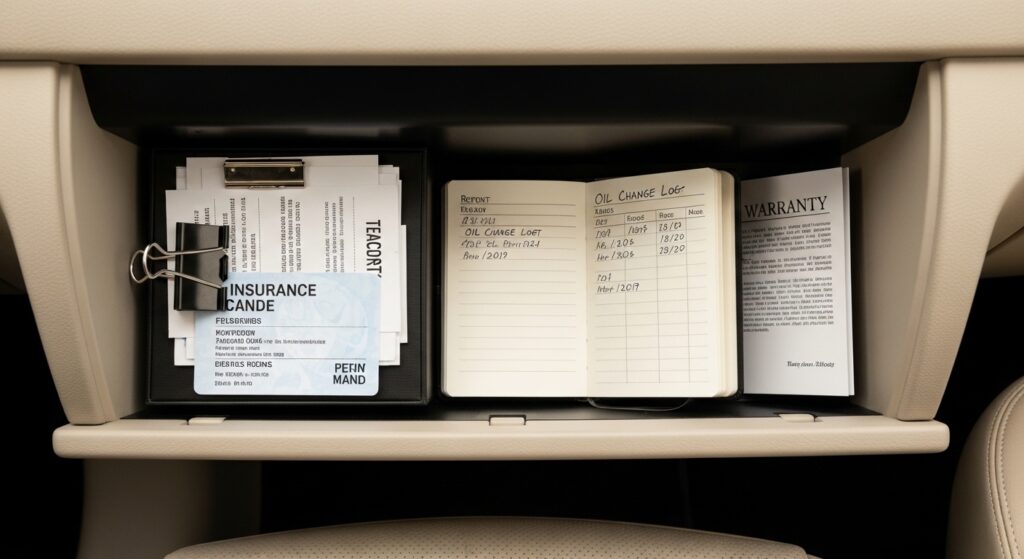
A good service receipt tells a story. It should show the date, the odometer reading, what was done, what parts were used, and the total cost. Vague receipts like “car serviced” mean almost nothing to a warranty company.
When you pick up your car from the shop, look at the receipt before you drive away. Make sure it lists the specific work: “oil change, 5W-30 full synthetic, oil filter replaced” is good. “Maintenance done” is not. If the receipt is vague, ask the shop to be more specific. You have every right to ask for a detailed invoice.
I once worked with someone who was shocked when her warranty claim was approved in under 48 hours. The service advisor told her it was the fastest processing he had seen. Her secret? She had every receipt organized by date in a small ziplock bag in her glovebox. Simple and effective.
How to Organize Your Glovebox for a Claim
A Simple System That Actually Works
The best organizing system is the one you will actually use. Here is what works for most people.
Get a small waterproof folder or a zip-up document pouch. You can find these for a couple of dollars at any office supply store. Label it “Car Documents.” Inside, keep two sections: one for permanent documents like registration and insurance, and one for recent service receipts.
Every time you get a service done, take the receipt and put it in the folder right away. Do not leave it on the seat. Do not stuff it in your bag. Put it in the folder before you start the engine. This one habit will save you hours of searching later.
For those who prefer going digital, services like Google Drive or Dropbox let you store scanned copies of all your documents. According to a guide published by Endurance Warranty, Google Drive gives you 15 GB of free storage and lets you access your files from any device. That means even if you lose the physical papers, you still have proof.
Physical vs. Digital: Which Is Better?
Honestly? Both. You want physical copies in the car for emergencies. You want digital backups at home or in the cloud in case of theft or a major accident.
If your car is stolen or totaled, your glovebox documents go with it. A digital backup of your vehicle identification number (VIN), warranty contract, and key service records means you are never starting from zero.
For daily driving, keep the physical folder simple and light. For long-term storage, go digital. This is not an either-or decision. It is a both-and solution.
Maintenance Records and Warranty Claims: What You Need to Know
What Warranty Companies Actually Look For
When you file a warranty claim, the provider checks a few key things. First, they want to know if the failed part is covered under your plan. Second, they check if you followed the required preventative maintenance schedule. If you skipped routine services, they may say the damage was caused by neglect.
This is not rare. It happens a lot. The warranty company is not being unfair. They just need proof that you did your part. Your job is simple: keep the receipts and log the services.
How to Speed Up the Claims Process
The faster you can give a repair shop or warranty company what it needs, the faster your claim moves. When a service advisor asks for proof of maintenance, you should be able to hand it over in 30 seconds.
Here is a quick checklist for a smooth claim process:
- Bring your glovebox folder to every repair appointment
- Have your VIN number written on your service receipts
- Keep the warranty contract terms somewhere you can read them fast
- Note any unusual sounds or symptoms before you go to the shop
- Ask the repair shop to contact the warranty provider directly if possible
The funny part is, when you are this organized, claim approvals feel almost easy. It is the drivers without records who end up waiting weeks and paying out of pocket.
Building Long-Term Habits for Better Record Keeping
Make Record Keeping a 2-Minute Habit
Most drivers do not track records because they think it is hard. It is not. All it takes is two minutes after each service visit.
Open your notebook or your phone app. Write the date, the mileage on the odometer, and what was done. Put the receipt in the folder. Done. That is it. Over a year, this small habit builds a complete service history that can save you thousands.
If you want even less friction, take a photo of every receipt with your phone immediately after service. Create a folder in your camera roll called “Car Records.” No special app needed. Just a habit that takes ten seconds.
Tracking Small Services Makes a Big Difference
Most people log oil changes. Fewer people log cabin air filter changes, wiper blade replacements, or tire pressure checks. But all of these are part of your routine maintenance and they all tell the story of a well-kept car.
I always say: log the small stuff too. If you checked your brakes and they were fine, write it down. Checked brakes, 4mm remaining.” That one note can answer a mechanic’s question months later and might be exactly what a warranty reviewer needs to see.
Do not try to go back and reconstruct years of history. Start fresh today. Create one entry with your current mileage and add every new service from here on. A partial record that grows is far better than no record at all.
Conclusion
The importance of maintenance records is not something you appreciate until you need them. By then, it is often too late. But starting today, with just a simple folder and a two-minute habit, you can build a vehicle service history that protects your investment, supports your warranty claims, and helps you get the most money when you sell.
Your glovebox is not just for random papers and forgotten parking tickets. It is your first line of defense when something goes wrong with your car. Keep it organized. Keep it current. And you will never have to scramble again.
I would love to hear your thoughts. Do you have a system you use for keeping car records? Drop a comment below or share your tip with someone who needs it.
Frequently Asked Questions
Why are maintenance records important for an insurance or warranty claim?
Maintenance records prove that you took care of your car the right way. Insurance companies and warranty providers use these records to check if your car was properly serviced before a problem happened. Without them, your claim can be delayed or denied. Keeping receipts and service logs is the easiest way to protect yourself.
What documents should I always keep in my glovebox?
You should keep your vehicle registration, a current insurance card, your warranty contract summary, recent service receipts from the last 12 months, and a small maintenance logbook. These are the papers you will most likely need in an emergency, at a traffic stop, or at a repair shop.
How long should I keep car maintenance records?
Keep records for as long as you own the car. If you sell the car, give the full service history to the buyer. This adds value and builds buyer confidence. For warranty purposes, many providers require records going back to the start of the warranty period. When in doubt, keep everything and sort out what to remove later.
Can I use digital copies of my maintenance records for a claim?
Yes, most warranty providers and repair shops accept digital copies. Scanned receipts, photos of service invoices, and records stored on Google Drive or Dropbox all work. It is a good idea to have both a physical copy in your glovebox and a digital backup saved in the cloud, so you are covered no matter what happens.
What if I lost my old maintenance records?
Do not panic. You can contact your old repair shops and ask for copies of past invoices. Many shops keep digital records for several years. You can also check your bank or credit card statements for the dates you paid for services. After gathering what you can, start fresh today and log every service going forward. A growing record is better than no record at all.