
You are driving and suddenly hear a strange tapping sound from under the hood. It gets louder when you press the gas. That sound is engine knocking, and it is your car telling you something is wrong. Ignoring it can cost you thousands of dollars. The good news? Most causes are easy to fix if you catch them early.
What Is Engine Knocking?
Engine knocking is a metallic pinging or rattling noise that comes from inside your engine. It happens when the air-fuel mixture inside the combustion chamber does not burn the right way. Instead of one smooth, controlled burn, parts of the mixture ignite at the wrong time. This causes tiny shockwaves that hit the piston walls and make that knocking sound.
Some people call it pinging, detonation, or spark knock. Whatever name you use, it means the same thing: the combustion cycle is off, and your engine is under stress.
What Does Engine Knock Sound Like?
Honestly, the first time I heard it in my old car, I thought something had fallen into the engine bay. It sounds like someone is shaking a tin can full of marbles. Other people describe it as a sharp rhythmic tapping that gets worse when you accelerate or climb a hill.
The sound can be soft at first. If you always drive with the music too loud, you might miss it early on. But as the problem gets worse, the knocking gets louder and more obvious. You may also feel slight vibrations through the steering wheel or notice the car feels sluggish.
Top Causes of Engine Knocking
Wrong or Low-Octane Fuel
This is the most common cause and also the easiest to fix. Every car needs a specific octane rating for its fuel. Your owner’s manual tells you exactly which grade to use. Regular, mid-grade, and premium fuel all have different octane levels.
When you use low-octane fuel in a car that needs premium, the fuel ignites too early. This is called pre-ignition. The fuel burns before the spark plug even fires, and the two flame fronts collide inside the cylinder. That collision is the knock you hear.
The fix is simple: switch to the correct fuel grade. Check your manual or the sticker near your fuel cap. If you have already filled up with the wrong fuel, top off with the right grade as soon as possible to dilute it.
Worn or Dirty Spark Plugs
I once put off a spark plug replacement for six months longer than I should have. Big mistake. The car started knocking on every hard acceleration, and my fuel economy dropped noticeably.
Spark plugs fire the air-fuel mixture at a precise moment. When they are old, dirty, or worn out, the timing goes off. The mixture does not ignite cleanly. This leads to incomplete combustion, misfires, and knocking sounds, especially under load. Replacing them at the recommended interval is one of the cheapest things you can do to protect your engine.
Carbon Buildup in the Combustion Chamber
Over time, carbon deposits build up on the pistons, valves, and inside the combustion chamber. These deposits create hot spots. Those hot spots act like tiny igniters, causing the fuel to ignite before the spark plug fires.
Carbon buildup also raises the compression ratio inside the cylinder. Higher compression plus a hot spot is a recipe for detonation. A professional fuel system or fuel injector cleaning service can remove these deposits and restore the engine to normal.
Low Engine Oil Level
This one can cause serious damage fast. Engine oil keeps all the moving parts lubricated. When the oil level is too low, parts like the engine bearings and connecting rods do not get enough lubrication. They start rubbing against each other. The heat from friction creates a loud knocking or thudding sound.
Check your oil dipstick regularly. If the level is low, top it up. If it keeps going low quickly, you may have an oil leak. That needs a mechanic right away.
According to a study from the U.S. Department of Energy, proper engine lubrication directly impacts engine efficiency and longevity.
Lean Air-Fuel Mixture
Your engine needs the right balance of air and fuel. When there is too much air and not enough fuel, the mixture is called lean. A lean mixture burns hotter. Higher temperatures make it much easier for the fuel to pre-ignite or detonate at the wrong time.
A lean condition can happen because of a vacuum leak, a faulty mass airflow sensor, or a broken fuel pump that is not sending enough fuel to the engine. A diagnostic scan at a shop can find the root cause quickly.
Bad Ignition Timing
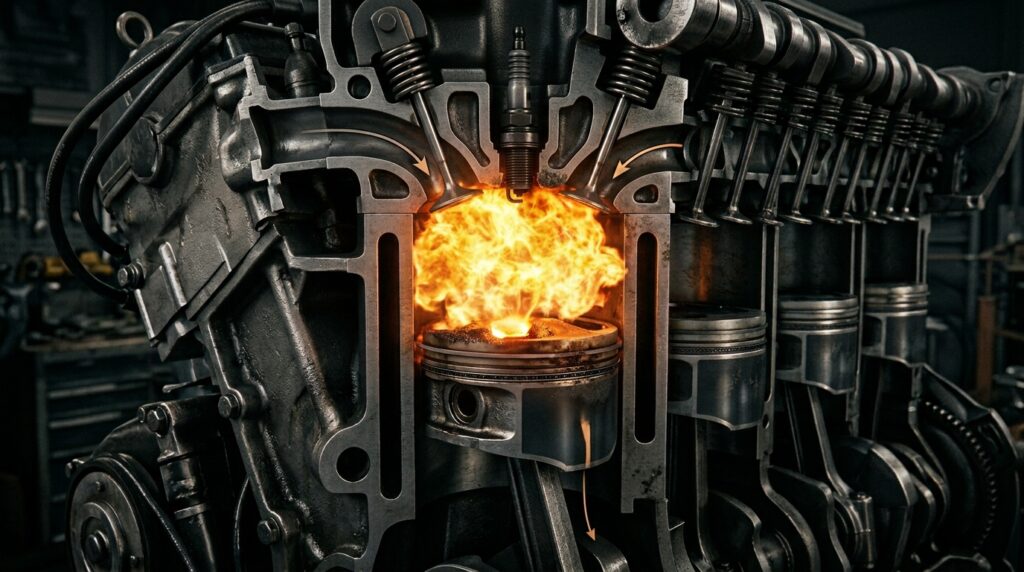
Modern engines use computers to control exactly when the spark plug fires. If the ignition timing is too advanced, meaning the spark fires too early in the piston stroke, it causes the mixture to burn at the wrong moment. This leads to knocking, especially during acceleration.
A faulty knock sensor, a bad camshaft position sensor, or a worn timing belt can all affect ignition timing. Most modern cars have a knock sensor that detects the problem and tries to self-correct. When that sensor fails, the engine cannot adjust, and knocking gets worse.
How to Diagnose Engine Knocking at Home
Simple Checks You Can Do Right Now
Before calling a mechanic, there are a few things you can check yourself. First, check your oil level using the dipstick under the hood. If it is low, add the correct grade of oil. Second, think about the last time you filled up with fuel. Did you use the right octane grade? If not, that may be the source of the knock.
Also, look at your dashboard. Is the check engine light on? A lit check engine light often points to a sensor or timing issue. Pay attention to when the knocking happens: at idle, during acceleration, or only when climbing hills. This helps the mechanic narrow down the cause faster.
When You Need a Professional Mechanic
Some causes of engine knock need a professional diagnostic scan. A mechanic will use a scanner to read fault codes from the engine computer. They may also use a stethoscope to listen closely to different parts of the engine and find where the sound is coming from.
If the knocking is deep and rhythmic with a heavy thudding sound, that usually means a rod bearing or crankshaft issue. This is serious, and you should stop driving right away. Continuing to drive with a rod knock can destroy the entire engine.
The National Institute for Automotive Service Excellence (ASE) recommends getting a certified technician to diagnose persistent engine noises.
Engine Knocking Fixes That Actually Work
Quick Fixes You Can Try Today
If your knocking just started, try switching to the correct octane fuel on your next fill-up. This alone fixes the problem for many drivers. You can also add a good-quality fuel system cleaner to the tank. This helps remove light carbon deposits and restore smoother combustion.
Check and top up the engine oil if it is low. Sometimes, low oil is all it takes to trigger a knocking sound. Use the oil grade listed in your owner’s manual. Do not mix different grades.
Repairs That Require a Mechanic
If the simple fixes do not help, you will need a mechanic. Replacing spark plugs is affordable and often solves the problem. A fuel system cleaning service can clear out deep carbon deposits. If a sensor like the knock sensor or oxygen sensor is bad, replacing it is usually not expensive.
More serious repairs like fixing a timing chain, replacing rod bearings, or repairing cylinder walls, cost more. These can range from a few hundred to several thousand dollars, depending on the extent of the damage. The earlier you catch the knock, the cheaper the fix.
How to Prevent Engine Knocking
Good Habits That Keep Your Engine Healthy
Prevention is always cheaper than repair. Always use the fuel grade your car needs. Change your oil on schedule and use the right oil grade. Do not skip your routine servicing appointments. These small habits protect the engine from the most common causes of knocking.
Replace spark plugs at the intervals listed in your manual. Keep your cooling system in good shape so the engine does not run too hot. Overheating raises combustion temperatures and makes knocking far more likely.
What Happens If You Ignore Engine Knocking
To be fair, a one-time mild knock from the wrong fuel may not cause immediate damage. But repeated or persistent knocking is a different story. Over time, it erodes piston surfaces, cracks cylinder walls, and destroys rod bearings. Repair bills can reach $4,000 or more for serious internal engine damage.
The funny part is that most engine knocking starts small and is fixable. People ignore it, and weeks later, they are looking at a full engine replacement. Do not let that be you. Act early and save yourself a lot of money and stress.
Conclusion
Engine knocking is one of those problems that seems scary at first, but is often very fixable. The most common causes are wrong fuel, worn spark plugs, carbon buildup, low oil, and bad timing. Start with the simple checks, use the right fuel and oil, and do not delay your regular maintenance.
If the knock persists or sounds deep and heavy, get to a mechanic fast. Catching it early is the difference between a $50 spark plug swap and a $4,000 engine repair. I would love to hear from you: have you ever dealt with engine knocking? What caused it in your case? Drop a comment below and let others know what worked for you.
Frequently Asked Questions
1. Can I drive with engine knocking?
You can drive short distances if the knock is very mild and only started from using the wrong fuel. But if the knocking is loud, deep, or gets worse while driving, stop the car right away. Driving with a serious knock can destroy your engine in a short time.
2. What is the most common cause of engine knocking?
Using the wrong octane fuel is the most common and preventable cause. Always check your owner’s manual and use the exact grade it recommends. This single habit prevents most knocking issues before they even start.
3. How much does it cost to fix engine knocking?
It depends on the cause. Replacing spark plugs can cost as little as $50 to $100. A fuel system cleaning runs around $80 to $150. More serious issues like rod bearings or timing chain repairs can cost $500 to $4,000 or more. The earlier you fix it, the less you pay.
4. Does engine knocking go away on its own?
Sometimes it does if the cause was simply the wrong fuel. Once you fill up with the correct octane, the knock may stop. But in most cases, engine knocking does not go away on its own and gets worse over time if you ignore it.
5. Can low oil cause engine knocking?
Yes. Low engine oil means moving parts like bearings and connecting rods do not get enough lubrication. The metal parts rub against each other and create heat and friction. This causes a loud knocking or thudding sound. Always keep your oil at the right level.