
Many families are one big bill away from a crisis. If you have ever stared at a utility bill and felt your stomach drop, you are not alone. The $300 service credit is a real form of deductible assistance that many people never know they can get. This guide will show you exactly what it is, who can get it and how to make the most of it.
What Is the $300 Service Credit?
The $300 service credit is a bill credit that certain programs give to low-income households to help them pay their utility bills. It shows up directly on your account as a one-time dollar-for-dollar reduction. Think of it like finding a $300 coupon in your mailbox, except it goes straight toward your past-due balance or your current charges.
Different programs offer this credit in different ways. Some apply it to your water bill, some to your electricity bill and some to your heating costs. The credit amount can reduce or sometimes fully eliminate what you owe.
Who Offers This Type of Credit?
Several well-known programs across the US offer a $300 account credit to qualifying customers. Here are a few real examples worth knowing:
Capital Region Water in Pennsylvania offers up to a $300 credit split as $150 for drinking water charges and $150 for wastewater charges for income-eligible residential customers.
Con Edison’s EnergyShare program in New York allows qualified customers to receive up to $300 toward their bill per season. You need to have made at least one good-faith payment and meet federal Home Energy Assistance Program (HEAP) income guidelines.
PG&E’s REACH program in California partners with the Dollar Energy Fund to give energy credits to customers who have received a disconnection notice and meet income requirements at or below 200% of the federal poverty level.
How the $300 Credit Helps Your Deductible Assistance
Here is the part most people miss. When you get a service credit, it does not just lower one bill. It frees up money in your budget for other costs you might be dealing with. That is the real power of deductible assistance programs.
I once helped a neighbor apply for a similar program. She was paying out of pocket for medical bills and had fallen behind on her water bill. When the $300 credit landed on her account, it was like someone lifted a weight off her chest. She used the money she saved to catch up on other overdue costs.
The credit acts as a form of financial relief that can stop a cycle of debt before it gets out of hand. If you are already enrolled in programs like LIHEAP, SNAP or CARE, you may automatically qualify.
Who Qualifies for the $300 Service Credit?
Qualifying is simpler than most people think. Each program has its own rules, but most share these common requirements:
You must be a residential customer on the account. You generally need to show proof of low household income, usually measured against the federal poverty guidelines or state median income levels. Many programs ask that your income be at or below 200% of the federal poverty level.
You may also need to show that you have a past-due balance or a disconnection notice from your utility provider. Some programs require that you have not received the same credit in the past 12 months.
Documents you often need include a government-issued photo ID, a recent pay stub or income statement, proof of your home address and sometimes an award letter from another assistance program like LIHEAP or SNAP.
How to Apply and Get Your Credit Fast
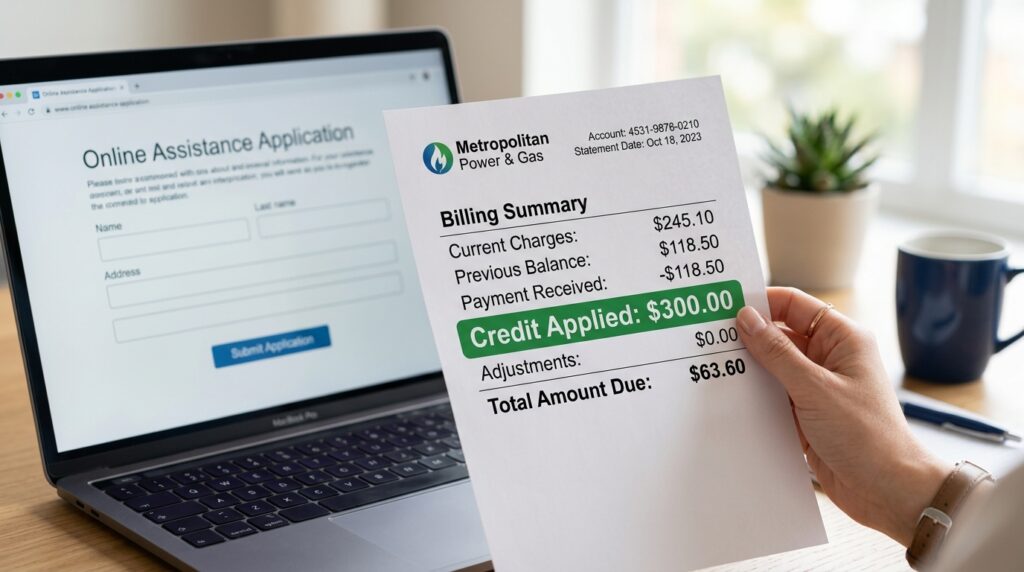
Applying does not have to be hard. Most programs let you apply online, by phone or in person. Here is a simple process that works for most programs:
First, find out which program covers your utility provider. Check your provider’s website or call their customer service line. Ask about their financial assistance programs and whether a $300 bill credit or service credit is available.
Then gather your documents. You will need your proof of income, a copy of your utility bill and your ID. If you already receive benefits like LIHEAP or SNAP, bring that award letter because it often speeds up the process.
Fill in the credit assistance request form accurately. Incomplete forms are the main reason people get delayed. Submit it and keep a copy for your records.
Maximize Your $300 Deductible Assistance: Smart Tips
Getting the credit is step one. Getting the most out of it is step two. Here is how you can squeeze every dollar of value from your deductible assistance:
Do not wait for a disconnection notice to apply. Some people think they have to be in a crisis to qualify. That is not always true. Apply as soon as your income falls in the eligible range.
Stack programs when possible. Many households qualify for more than one type of help. For example, you may get the $300 service credit from your water provider while also receiving monthly bill credits through the Universal Service Fund (USF) or a FERA discount on your electricity.
Keep all your health benefit statements and award letters. These documents are proof that you paid toward your balance. They also help when applying for credits in future years.
Renew every year. Most programs only give this credit once every 12 months. Mark your calendar and reapply when you become eligible again.
Common Mistakes People Make When Applying
Honestly, the most common mistake is just not applying at all. People assume they will not qualify or think the process is too complicated. That thinking costs families hundreds of dollars every year.
The second mistake is sending incomplete paperwork. If your income documents are missing or your address proof is out of date, your application gets put on hold. Always double-check what documents are needed before submitting.
Another mistake is not telling your utility company about a personal crisis early enough. Most companies, including those with REACH programs and EnergyShare, have payment arrangements and extended due date options that can buy you time while you wait for your credit to be processed.
Can You Combine the Credit With Other Programs?
Yes and this is where things get really exciting. Many families do not realize that the $300 service credit is just one layer of help available to them.
According to the U.S. Department of Health and Human Services, the Low Income Home Energy Assistance Program (LIHEAP) provides additional heating and cooling cost assistance on top of what utility programs offer. You can often receive both at the same time.
The Consumer Financial Protection Bureau (CFPB) also notes that nonprofit credit counseling services can help you manage bills and plan payments so you stop falling behind in the first place. Combining bill credits with a solid payment plan is one of the most powerful things you can do.
Some states even have arrearage management programs (AMP) that will forgive old past-due balances bit by bit as long as you keep paying your new bills on time. So the $300 credit could be the door that opens a whole room full of financial help.
How the Credit Shows Up on Your Bill
This is something many first-time applicants get confused about. The $300 service credit usually appears as a one-time account adjustment or a billing credit on your next statement. It does not come to you as a check in the mail.
When you see it on your bill, it will typically reduce the total amount due. If your balance is lower than $300, the remaining credit may carry forward depending on the program’s rules. Always read your bill carefully after applying so you know the credit was applied correctly.
If you do not see it within the expected time frame, call customer service and ask them to confirm the status of your credit assistance request.
Conclusion
The $300 service credit is one of the most useful and most overlooked forms of deductible assistance available to everyday families in the US. It can lower your utility bill, stop a disconnection and give you breathing room when money is tight. The key is knowing it exists, knowing you may qualify and taking the simple steps to apply.
Do not let paperwork fear or doubt hold you back. Programs like REACH, EnergyShare, Capital Region Water’s assistance program and LIHEAP are funded for people exactly like you. Apply, stack the benefits and renew every year. Every dollar saved is a dollar you can put back into your family.
I would love to hear from you. Have you ever applied for a service credit or utility assistance program? Drop your experience in the comments below.
Frequently Asked Questions
What exactly is the $300 service credit?
The $300 service credit is a bill credit applied directly to your utility account by qualifying financial assistance programs. It reduces the amount you owe on your water, electric or gas bill by up to $300. It is not a cash payment but a dollar-for-dollar reduction on your account balance.
How do I know if I qualify for deductible assistance?
Eligibility usually depends on your household income being at or below a set percentage of the federal poverty guidelines or state median income. You may also need a past-due balance or a disconnection notice. Checking with your utility provider’s customer service team is the fastest way to find out.
Can I apply for the $300 credit more than once?
Most programs allow you to apply once every 12 months. If you qualify the following year again and still meet the income requirements, you can reapply. Always renew your eligibility documents and submit your application as soon as the new program year opens.
Does the $300 service credit affect my taxes?
In most cases, utility bill credits are not counted as taxable income because they are assistance payments applied to your account rather than cash you receive. However, if you are unsure, a quick call to a tax professional or checking with the IRS can give you peace of mind. (No reliable 2024-2025 source available confirming universal tax treatment for all state programs.)
What if my application for the $300 credit is denied?
If your application is denied, ask the program for the specific reason. Many denials happen because of missing documents or income that is slightly above the limit. You can resubmit with updated paperwork or ask about other financial assistance programs your utility provider may offer such as payment arrangements, extended due dates or budget billing options.