
Think of your engine like a pump. Every time the piston moves up inside a cylinder, it squeezes the air-fuel mixture into a tiny space. That squeezing is called compression. The tighter the squeeze, the more power the engine makes when the spark plug fires.
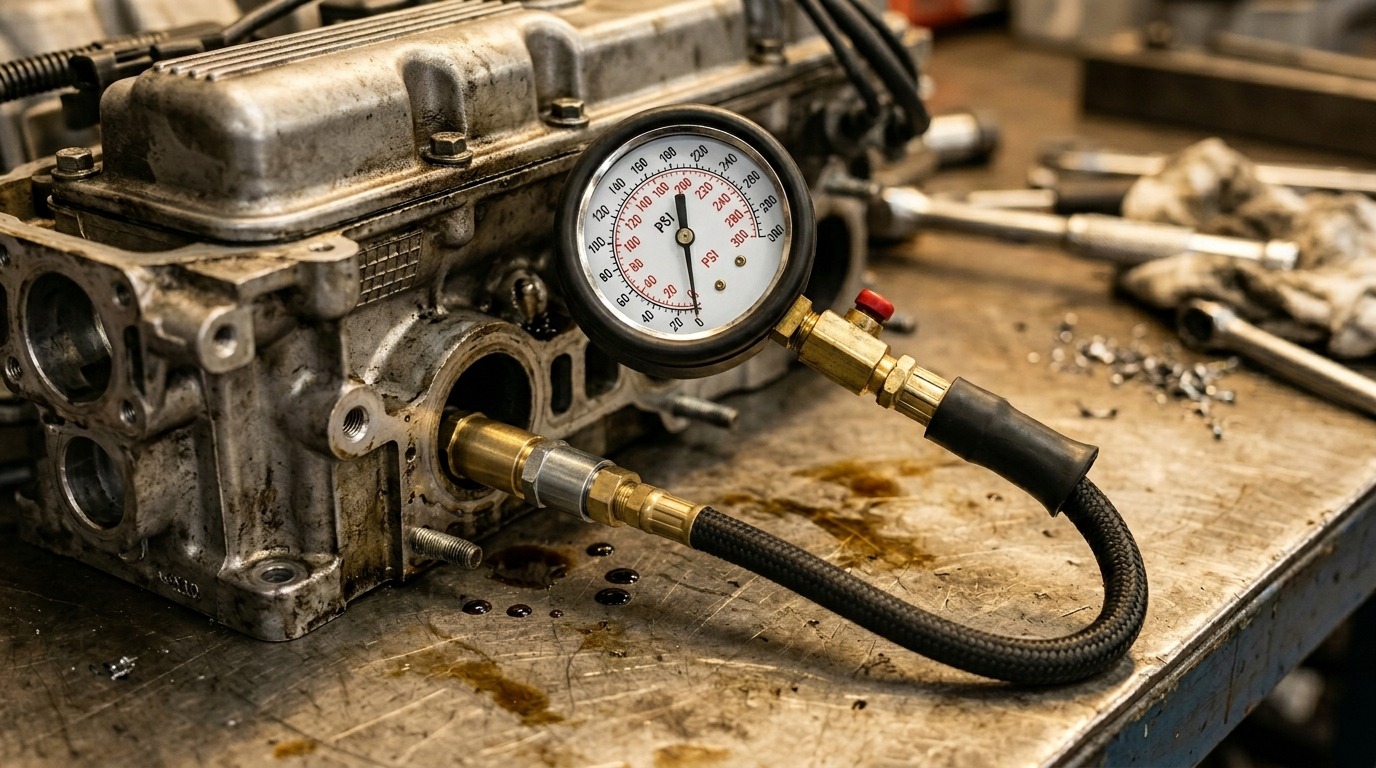
An engine compression test is a simple check that measures how much pressure each cylinder is producing. The pressure is measured in PSI (pounds per square inch). If the pressure is good and even across all cylinders, your engine is healthy. If one or more cylinders show low or no pressure, something inside is worn or broken.
Why Does Compression Matter for Your Engine?
Without proper compression, your engine cannot burn fuel correctly. No good burn means no power. Think of it like trying to squeeze toothpaste out of a tube with a hole in it. Nothing comes out right.
According to a technical guide from AutoZone (2026), your engine needs four things to run properly: fuel, spark, timing, and compression. If any one of those is missing, problems follow fast. A compression test helps you find out whether compression is the problem or not.
What Does an Engine Compression Test Tell You?
Engine Problems It Can Find
I once saw a friend spend $400 replacing spark plugs and ignition coils on his truck, only to find out later the real problem was worn piston rings. A simple compression test done first would have saved him all of that money and time.
A compression test can help spot problems like:
| Problem | What the Test Shows |
| Worn piston rings | Low compression in one or more cylinders |
| Leaking valves | Low or zero reading in a cylinder |
| Blown head gasket | Low readings in two side-by-side cylinders |
| Carbon buildup | Unusually high compression reading |
| Broken valve spring | Very low or zero reading in one cylinder |
| Bad timing chain/belt | Low readings across all cylinders |
What Is a Good Compression Reading?
For most gasoline engines, a healthy cylinder pressure is between 140 and 160 PSI. Some high-performance engines can go up to 220 PSI. For diesel engines, the reading is much higher, usually around 350 PSI or more, because diesel fuel ignites from heat alone without a spark plug.
The most important thing to check is consistency. According to data shared by Apex Industries, all cylinders should be within 10% of each other. So if your highest cylinder reads 160 PSI, your lowest should be no less than 144 PSI. If any cylinder is more than 10% lower, you have a problem that needs checking.
Quick Rule for Gas Engines: Target cylinder pressure is roughly 15 to 20 times the engine’s compression ratio. For example, a 10:1 compression ratio engine should produce between 150 and 200 PSI.
When Should You Do a Compression Test?
Signs Your Car Needs a Compression Test
Honestly, a lot of car owners wait too long before doing this test. Your car usually tells you something is wrong before things get really bad. Watch out for these signs:
If your engine is misfiring, running rough, losing power on the highway, or burning more fuel than normal, these are big hints that your cylinder pressure may be off. You might also notice blue smoke coming from the exhaust, which often points to worn piston rings letting oil burn inside the engine.
Also, if your car is hard to start or just cranks and cranks without firing up, low compression could be why. An engine needs at least 100 PSI in a cylinder just to start running at all.
Compression Test as Preventive Maintenance
You do not have to wait for a problem to check compression. Many mechanics suggest doing a compression test as part of a regular tune-up. This is especially smart if your car has over 100,000 miles on it or if you are thinking about buying a used car.
If you are buying a used vehicle, ask for the compression numbers. A seller who has solid, even numbers is giving you proof the engine is in good shape. As noted by racing experts at NASA Speed News (2024), buyers of used racecars always want compression numbers, and sellers who have them ready build instant trust.
How to Do an Engine Compression Test Step by Step
Tools You Will Need
You do not need a fancy garage to do this test. The main tool is a compression gauge or compression tester kit. These kits come with a gauge and a set of adapters that screw into the spark plug holes. You can buy one for around $20 to $50 or even rent one from an auto parts store.
You will also need a spark plug socket, a ratchet, an extension, a notepad to write down readings, and safety gloves. That is basically it. Nothing complicated at all.
The Compression Test Procedure
The steps below work for most gasoline engines. Diesel engines need a special high-pressure gauge and a slightly different setup.
- Warm up the engine fully before you start. A cold engine gives lower and less accurate readings.
- Disable the ignition system so the engine cannot start during the test. Disconnect the coil or pull the relevant fuse.
- Disable the fuel system too. Pull the fuel pump fuse or disconnect the fuel pump relay.
- Remove all spark plugs from every cylinder. Removing all of them makes it easier for the engine to crank freely.
- Thread the compression tester adapter into the first spark plug hole. Hand-tight is fine since it has an O-ring seal.
- Hold the throttle wide open and crank the engine for the same number of revolutions for every cylinder, usually 4 to 6 turns.
- Read and write down the PSI reading on the gauge. Press the release button to reset the gauge before testing the next cylinder.
- Repeat this for every cylinder and compare all the readings.
The key thing many people miss is keeping the throttle fully open. Testing with the throttle at idle will give you lower numbers and a false result, as pointed out by the compression testing guide from NASA Speed News.
How to Read and Understand Compression Test Results
What Low Compression in One Cylinder Means
If just one cylinder shows a much lower reading, the problem is local to that cylinder. It could be a leaking valve, a broken valve spring, a worn piston ring, or even a cracked cylinder head. There is a quick trick to figure out which one it is.
Pour about a teaspoon of clean engine oil into that cylinder through the spark plug hole and run the test again. If the reading goes up after adding oil, your piston rings are worn. The oil temporarily seals the gap around the rings, giving higher pressure. If the reading stays low even with oil, the problem is most likely a leaking valve and not the rings.
What Low Compression in Two Adjacent Cylinders Means
Two cylinders next to each other both showing low readings is a red flag. This almost always points to a blown head gasket between those two cylinders. A head gasket sits between the cylinder head and the engine block, and when it fails, it lets pressure escape from one cylinder into the next.
A blown head gasket is one of the more expensive repairs on a car. So if you see this pattern in your test results, get it checked by a professional right away before it causes worse damage to the engine.
What High Compression Means
High compression readings are less common but they happen. Usually, this means there is excessive carbon buildup inside the combustion chamber. Carbon deposits stick to the top of the pistons and the inside of the cylinder head, reducing the empty space and pushing compression numbers up.
This can cause problems like engine knocking and pre-ignition. The fix usually involves physically removing the cylinder head and cleaning out the carbon, or in some cases using a chemical de-carbonizing treatment.
Static Compression Test vs Running Compression Test
What Is a Static Compression Test?
The step-by-step method we just covered is called a static compression test. It is done with the engine cranking but not running. You crank the engine a few turns, capture the peak pressure, and record it. This is the most common method and the easiest for a beginner to do at home.
It checks whether the pistons, rings, valves, and head gasket can hold pressure. Think of it as a snapshot of the engine’s health at one moment in time.
What Is a Running Compression Test?
A running compression test is more advanced. As described by ALLDATA, it is done while the engine is actually running and it measures volumetric efficiency. In other words, it checks how well each cylinder breathes air in and out during normal operation.
This test is great for diagnosing a misfire when all other tests look normal. It can also tell you if a camshaft lobe is worn or if an intake or exhaust valve is not opening and closing properly. It is mostly done by professional mechanics since reading a gauge on a running engine takes some practice.
Conclusion
An engine compression test explained simply is this: it is a fast, affordable way to check whether your engine’s internal parts are doing their job. It uses a compression gauge screwed into each spark plug hole to measure the pressure each cylinder builds during cranking.
Good, even readings mean a healthy engine. Low readings in one cylinder point to rings or valves. Low readings in two cylinders side by side usually mean a blown head gasket. High readings often mean carbon buildup. The test costs very little, takes under an hour, and can save you thousands in unnecessary repairs.
Whether you are doing regular maintenance, buying a used car, or chasing a misfire, an engine compression test is always a smart first step. Have you ever done one yourself or had one done? I would love to hear how it went for you.
Frequently Asked Questions
How much does an engine compression test cost?
If you do it yourself, the only cost is the compression gauge, which can be as low as $20. Many auto parts stores also let you rent one for free as long as you return it. If you take your car to a mechanic, the test usually costs between $50 and $150 depending on the number of cylinders and the shop’s labor rate.
Can I do a compression test on a cold engine?
You can, but warm is better. A cold engine gives lower and less accurate PSI readings because the metal parts have not expanded to their normal size yet. Most mechanics recommend warming the engine fully before testing for the most reliable results.
What is the minimum compression an engine needs to start?
An engine generally needs at least 100 PSI in each cylinder to start and run. Below that, the engine either cranks without starting or runs very rough and weak. If your readings are below 100 PSI across multiple cylinders, the engine may need major internal work.
Is a compression test the same as a leak-down test?
No, they are different. A compression test measures the peak pressure a cylinder can build by cranking the engine. A leak-down test pumps compressed air into a stopped cylinder and measures how much leaks out. The leak-down test is more precise and can tell you exactly where the pressure is escaping, but a compression test is faster and easier to do first.
What causes low compression in all cylinders at once?
When all cylinders show low compression at the same time, the usual causes are severely worn piston rings and cylinder walls, a timing problem (the timing chain or timing belt is off), or fuel-washed cylinders where too much fuel has stripped the oil film from the cylinder walls. This last one often happens in flooded or heavily over-fueled engines.